Friday, March 14, 2014

Travel Day


Home for the next few days.
It was a pretty long travel day today.  I made it to Edmonton this afternoon in time to buy some supplies for the weekend workshop and get a long overdue haircut.  My laptop was giving me some grief, but its working again.  I don't need it right away, but I need to finish putting together a powerpoint presentation for talks in Red Deer and Saskatoon next week.  But for now I'm having an early night tonight and an early morning tomorrow knapping with the Archaeological Society of Alberta's Strathcona Centre at the University of Alberta.

Photo Credit: Tim Rast

Wednesday, March 12, 2014

MUNArch Percussion Workshop


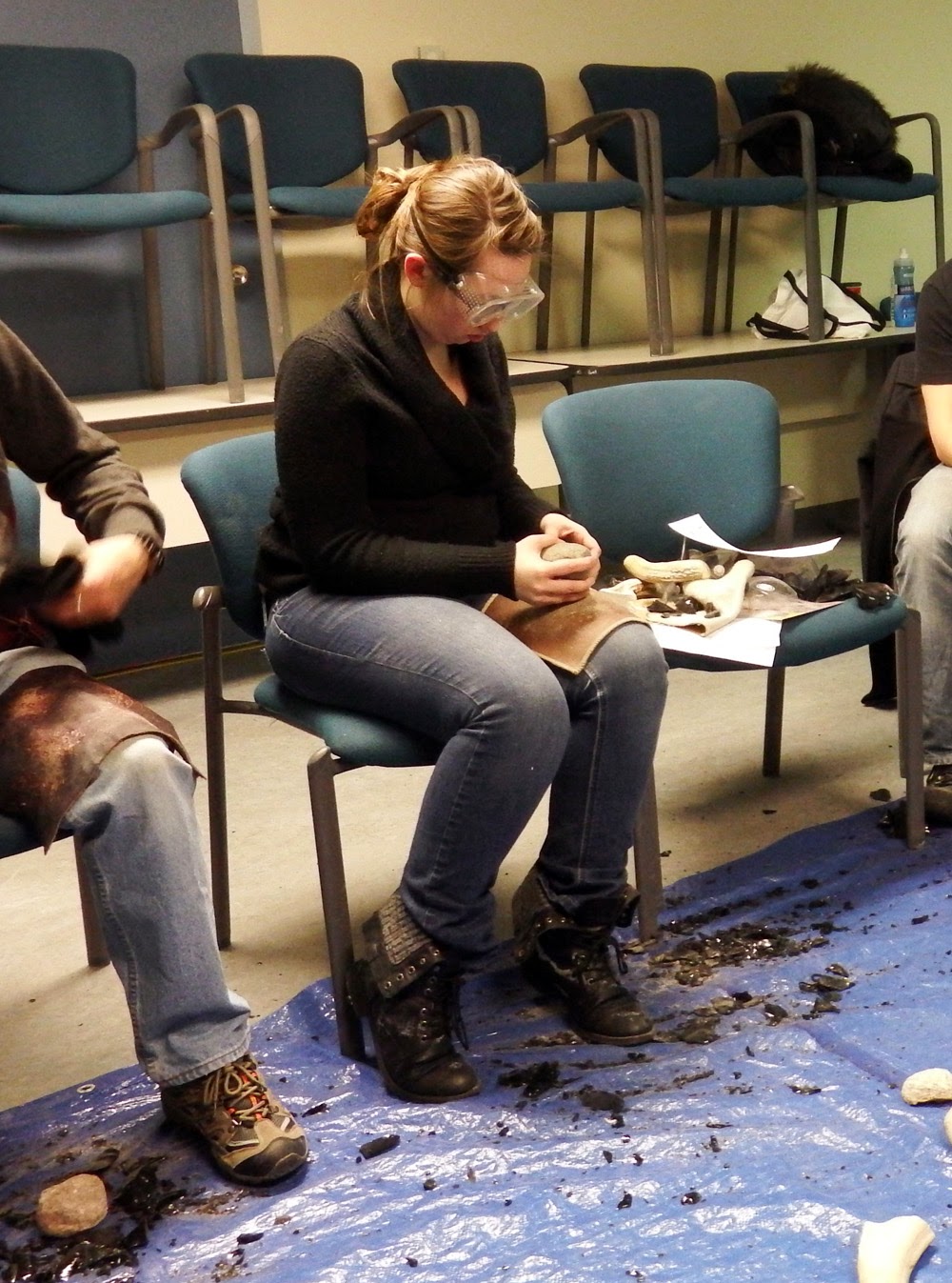
We are at the halfway point in the MUNArch flintknapping wokrshops.  Three of the six evenings have gone ahead and its been going great so far.  Last week we made ground stone ulus and this week we are working on hard and soft hammer percussion.  I'm off to Alberta and Saskatchewan for more workshops next week, but we'll be back at it in St. John's on March 24th and 26th to finish up with an introduction to pressure flaking.

Some impressive bifaces came out of the first round of Percussion knapping.

A lot of focus.  The room can get pretty quiet at time, except for the sounds of rock breaking.


Photo Credits: Tim Rast

Monday, March 10, 2014

Fitting the Beothuk Harpoon Head

Will it fit?
I got as far as fitting the Beothuk harpoon head onto the wood mainshaft this weekend.  If you recall, the Beothuk harpoon heads have a very thin slit at the base to fit onto the harpoon shaft.  Also, according to Shawnadithit's drawing, Beothuk harpoons lacked the foreshaft seen in many other cultures in the Province, including the Maritime Archaic, Palaeoeskimo, and Inuit.  Before making the reproduction, I had a difficult time reconciling this extremely narrow socket with an all wood harpoon shaft.  It seemed like the harpoon shaft would have to be carved to the thickness of a credit card in order to fit into the thin slot.  I couldn't imagine wood being strong enough to fit such a narrow slot without breaking.  I thought perhaps the Beothuk fit the harpoon heads onto the ends of metal lances, although this is contrary to Shawnadithit's drawing.  After this weekend, I don't believe that anymore, and I think Shawnadithit's drawing of a foreshaft free harpoon could be accurate.

It does!
The main thing that became obvious from making the reproduction was that the thin slot on the Beothuk harpoon is also quite wide.  Near the end of the spurs, it may only be a millimetre or two thick, but it stretches nearly an inch from side-to-side.  I think the trick to fitting the harpoon head onto a wood shaft is to mimic the diamond cross-section of the harpoon head in the wood shaft.  It only has to be thin where it makes contact with the harpoon head socket.  If the shaft is left thick in the middle but tapers towards the edge, then it seems to solve both problems; it fits into the very thin socket, but maintains some strength.

The edge can be slightly charred in a
flame and the charred edge ground
away to create a strong, smooth
edge.
A lozenge shaped or diamond shaped cross-section at the end of the long wood main shaft would work and is relatively easy to make.  Its a form that is easy to make by scorching the wood with fire and abrading the edges against a stone.  We know the Beothuk used fire to both shape wood and season it, so this would fit within their technological approach to woodworking, as well.  For example, a birch bowl was found at the capture of Mary March that was in the process of being hollowed out with fire and there is an historic account of the Beothuk seasoning their bows over fire to dry and strengthen them.  Using fire to shape the shaft would have the added advantage of further hardening the wood.

It only has to be thin around the edge.  The middle can be
left thick, mimicking the diamond cross-section of the
harpoon head.
I probably had enough information to figure this out logically, but, as is often the case, figuring it out in the workshop was a lot easier.   Dorset Palaeoeskimo harpoon heads in this province have a tendency towards being rectangular in cross-section and fit on a rectangular foreshaft.  Likewise, Inuit harpoon heads tend to have a round or oval cross-section and fit onto a round or oval foreshaft.  The Beothuk harpoon heads have a diamond cross-section, so why shouldn't we suppose that they would fit onto a shaft that also has a diamond cross-section?  Its a pattern that I hadn't really noticed before, or explained away as being related to gouged versus drilled holes, but perhaps there is a pattern across many cultures in the northeast that sees foreshaft cross-section mirror the harpoon head cross-section.  If I would have noticed that pattern earlier, it might have made understanding Beothuk harpoon heads less perplexing.

Photo Credits: Tim Rast

Friday, March 7, 2014

Beothuk Harpoon Head progress

Reproductions and
photo references
The Beothuk harpoon is coming together.  I have all of the pieces on hand, I just need to do some finishing and assemble it.  The harpoon head style is influenced by Dorset designs, but I don't think anyone has established whether or not that influence came directly from interaction between the two groups or if the Beothuk found Dorset artifacts and copied them after the Dorset became extinct.  There were several hundred years when the Dorset and the ancestors of the Beothuk shared the Island of Newfoundland, but its hard to know how many face-to-face interactions they had.  We also don't know how old Beothuk harpoon technology is.  All of the evidence that we have for Beothuk harpoons and harpoon heads come from the last century or two that they were around.

The two holes on the opposite face
meet in a single hole on this side.
At this stage, the harpoon head is blocked out and I'm shaving off millimetres, or fractions of millimetres here and there to match the original artifacts.  I'm making two, so that I'll have one for my own collection after I mount the other on the complete harpoon for the Mary March Museum.  I used an old kitchen knife for the metal endblades.  The original harpoon head has an iron blade cut from a flat sheet of metal, perhaps the pan of a metal trap (McLean 2003).  The endblades are a little shinier than I want them to be when the harpoon heads are complete, so I'll touch them up with muriatic acid to get a weathered, rusty finish to them.  Likewise, the harpoon head will be ochre stained to match the original artifacts.

I got permission first.  Its still a good cleaver.

The pencil marks are there to guide the next round of cutting and shaping, but its very nearly done.

References:
McLean, Laurie
2003 A Guide to Beothuk Iron. NAHOP Artifact Studies 1. Memorial University of Newfoundland.

Photo Credits: Tim Rast

Wednesday, March 5, 2014

March is going to be busy

An Open Minds workshop at The Rooms
It's kind of a hectic month.  I still have a couple big orders to fill in the studio, but workshops and demonstrations have really piled up in my March schedule as well.  At the moment,  I have 14 workshops, one knapping demonstration and a public talk scheduled across three different provinces during the month of March.  Some of those workshops are with elementary school kids while others are with university students and members of archaeological societies in Alberta and Saskatchewan.

Securing the gut hafting on an ulu
at a MUNArch workshop.
Tonight is the second MUNArch ground stone ulu workshop.  We had 10 people come out on Monday night and everyone finished a slate ulu.  This is basically the same workshop that I do with the Open Mind's students at The Rooms, but we use sinew and gut lashing instead of string and people are responsible for chipping their own blanks and cutting their own handles.  For kids, we start with sawed blanks and handles that are already cut to length.

A Little Passage
(pre-contact Beothuk) knife,
ready to glue and lash together.
In the studio I'm continuing to work on Beothuk and Intermediate period reproductions.  The Intermediate period pieces must match a specific suite of artifacts from Sheshatshiu, Labrador, while the Beothuk pieces can be a little more generic.  I'm pulling from a lot of different archaeological and historical references for the Beothuk pieces.  For example the knife on the right is based on a biface found by Ralph Pastore on Inspector Island but the handle comes from a wood handle that was photographed by James Howley for his 1915 publication, The Beothuck or Red Indians.  For the Intermediate period pieces from Sheshatshiu, I'm using ethnographic Innu artifacts to help fill in some of the blanks.

The scraper in the upper left hand corner is meant to be a reproduction of the scraper in the photo immediately below it.

The original artifacts will be shown in the display as they were found and the reproductions will illustrate how they may have appeared to the people who originally made them, complete with lashings and handles and all the missing pieces that were not preserved in the ground.
Photo Credits: Tim Rast

Monday, March 3, 2014

Spring 2014 Flintknapping Workshops in Edmonton

I'll be teaching a pair of flintknapping workshops in Edmonton on the weekend of March 15 and 16th at the University of Alberta.  These workshops are generously sponsored and organized by the Strathcona Archaeological Society, The Archaeological Society of Alberta, and the University of Alberta Department of Anthropology.  Saturday's workshop will be an introductory day where we will learn the basics of hard and soft hammer percussion as well as pressure flaking.  No experience is necessary, but if you have tried knapping before, this will be a good opportunity to refresh your skills and troubleshoot problem pieces. On Sunday we will focus on ground slate ulus and stone drills.  Make a stone tipped drill in the morning and use it to drill the lashing holes in your slate and wood ulus in the afternoon. Contact arkyedmonton (at) gmail.com to register.


Friday, February 28, 2014

MUNArch Stone Tool Making Workshops 2014

Obsidian Biface
Beginning next week, MUNArch, the Memorial University of Newfoundland undergraduate archaeology society will be sponsoring three weeks of flintknapping and ground stone tool making workshops.  I'll be leading the workshops and the first sessions are on the evenings of Monday, March 3rd and Wednesday, March 5th.  The first workshops happen in less than a week, so if you are interested in attending, please contact MUNArch as soon as possible to reserve your space: munarch@gmail.com

2013 MUNArch workshop
There are three different workshops offered and each is available on either a Monday or Wednesday evening, with a maximum capacity of 15 people in each session.  These are all introductory classes, so no experience is necessary.  If you have previous experience and some more advanced questions, please feel free to join us and I'll work with you as best I can.

Week 1: Ground Stone Ulus

Ground Slate Ulu
Learn to chip and grind ground stone ulus from flat slabs of slate.  Drill through the slate with a bow drill, prepare a wood handle and lash it into place.  This is the first time that this workshop has been offered through MUNArch in St. John's.
Monday, March 3rd or Wednesday, March 5th

Week 2: Introduction to Percussion Knapping

Biface made with percussion
Learn the basics of hard hammer and soft hammer percussion.  Strike a flake from an obsidian core and learn how to thin and shape the flake using stone and antler percussors.
Monday, March 10th or Wednesday, March 12th

Pressure flaked glass and
obsidian arrowheads

Week 3: Introduction to Pressure Flaking

Learn to use pressure to push small, controlled flakes off of your stone tools.  Pressure flaking is how you turn a flake into an arrowhead.
Monday, March 24th or Wednesday March 26th
(Note that this follows two weeks after the percussion workshop, I'll be out of town March 17 and 19th)


The costs for the sessions are as follows:
$50 for all three sessions (3)
$40 for two sessions (2)
$25 for one session (1)

The time for each event will be 6:00 pm, in QC 4028 in Queen's College on the MUN Campus (next to Bitters). Ages 16 and up. If you wish to attend any of these workshops, please email MUNArch at munarch@gmail.com.

Photo Credits:
1,2,4,5: Tim Rast
3: Phillip Cairns, courtesy of Labrador CURA
Related Posts with Thumbnails