Showing posts with label MUNARCH. Show all posts

Friday, March 27, 2015

It's all still worth it.

The Happiest Little Ulu
Its Friday night and the week just keeps rolling along.  Tomorrow we have an NLAS Board meeting and on Sunday I have housework.  I'm not terribly good at multi-tasking, so this week has kept me hopping.  Most of Wednesday was dedicated to preparation for all the different meetings that I had lined up for Thursday.  On Thursday morning I worked with the Open Minds students at The Rooms, where we talked about Inuit tools and experimental archaeology and then made ground stone artifact reproductions.

Always a favourite teacher and class to work with in the Open Minds program at The Rooms

Getting closer...
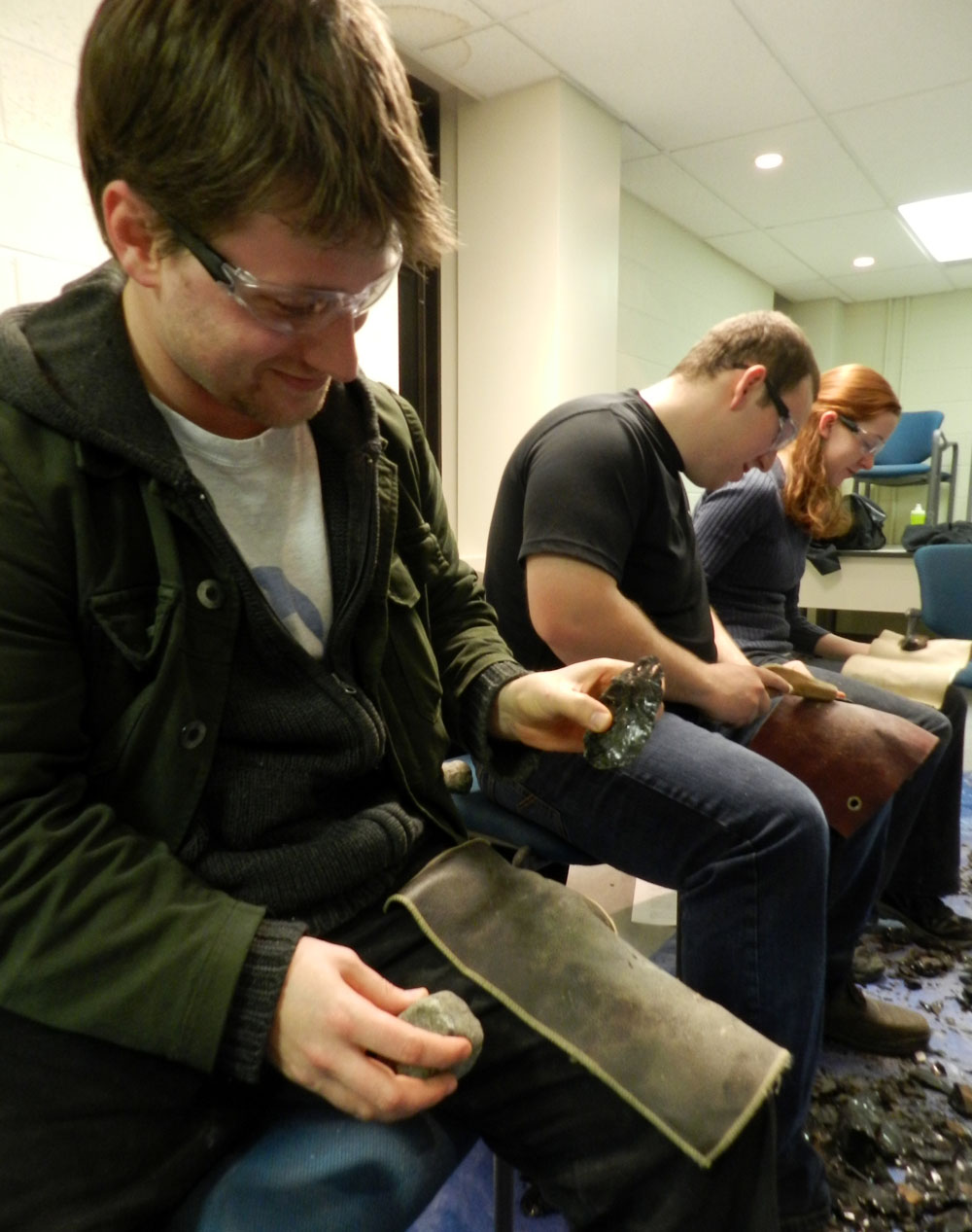
Since I was at The Rooms already, I popped down to the archaeology lab and visited the Ikaahuk artifacts.  There's a certain amount of deep breathing necessary to transition from working with two dozen 10 year olds to planning millimetre by millimetre cuts to antler and ivory reproductions.  In the afternoon I played catch-up on e-mail then in the evening we had our last evening of the MUNArch flintknapping workshop, where we worked with glues and sinew to haft stone tools.

Knapping and hafting tools in the Great Hall with MUNArch
 Photo Credits: Tim Rast

Monday, March 23, 2015

MUNARCH Pressure Flaking

We had a good mix of seasoned knappers and new comers at the MUNArch pressure flaking workshop this evening.  Here is a sampling of the points produced this evening.  It's always fun to see what people come up with.


Photo Credits: Tim Rast


Friday, March 20, 2015

MUNArch Flintknapping

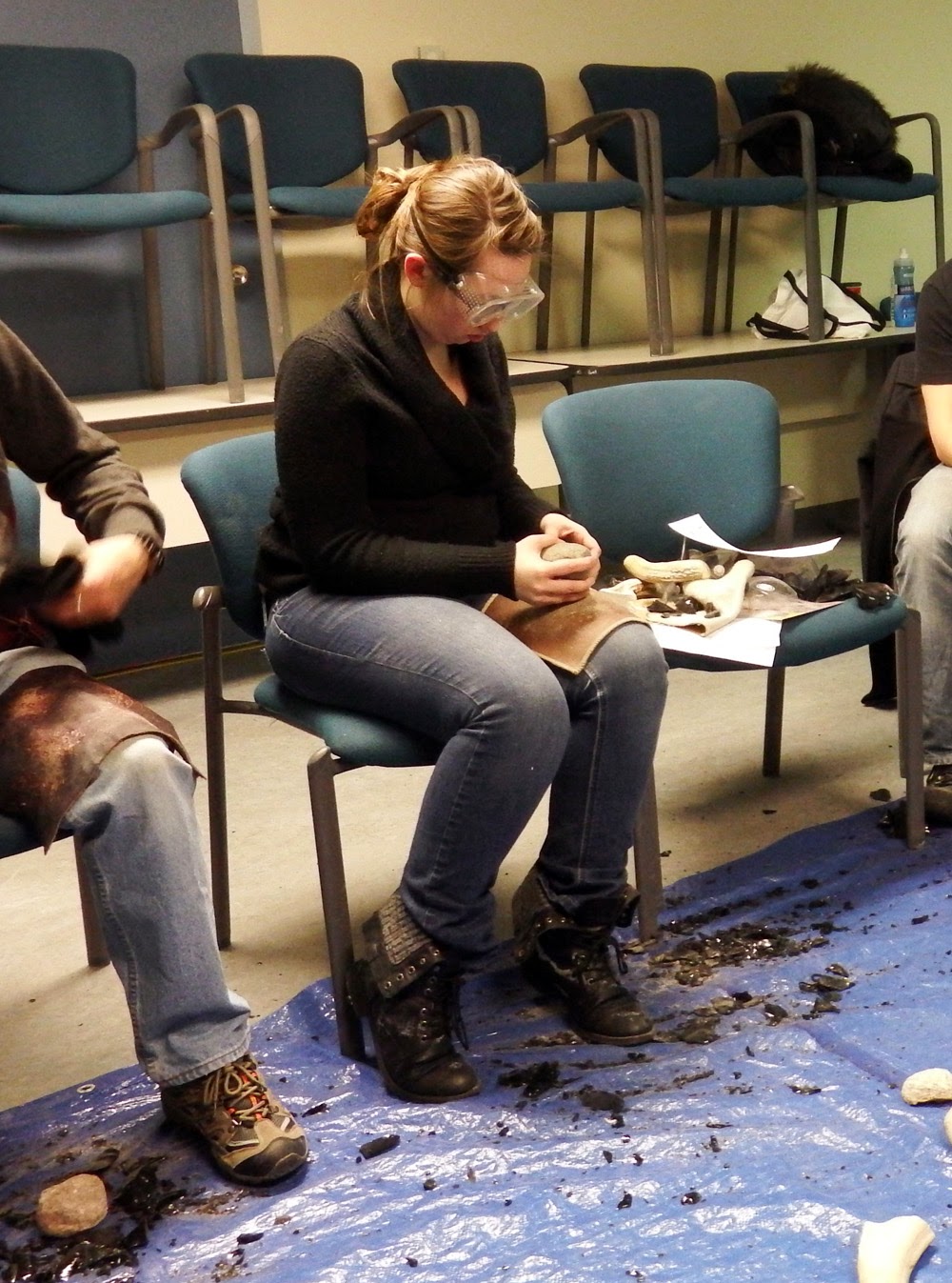
A dedicated group in the Great Hall at Queen's College
We were delayed a few days in starting the 2015 MUNArch flintknapping workshop due to the blizzard on Monday, but we were able to begin percussion knapping on Thursday night.  Next Monday we will work on pressure flaking and then finish with hafting our tools next Thursday.

A few pieces for display

Photo Credit: Tim Rast

Monday, February 23, 2015

MUNArch Flintknapping 2015

Obsidian and
chert arrowheads
MUNArch, the archaeology student association at Memorial University of Newfoundland, is once again sponsoring a flintknapping workshop this March.  The event will be held over 3 evenings, March 16, 19, and 23rd in the Great Hall at Queen's College on the MUN campus in St. John's.

March 16: Introduction to Percussion Knapping

In this class, students will learn the basics of using hammerstones and antler billets to strike flakes from cores. By the end of the evening, you will have produced your own hard hammer and soft hammer flakes, a uniface and a biface.

Percussion knapping using hammerstones and antler billets
   

March 19: Introduction to Pressure Flaking

Learn how to use copper and antler tools to turn flakes into arrowheads and other stone tools by pushing off small, precise flakes.

A copper-tipped pressure flaker, obsidian arrowheads, and a hammerstone

March 23: Special Projects 

Put your new skills to use to make a complete stone tool.  Work with sinew, wood, and natural glues to haft your knapped work.

Hafted stone tools

Start time is 6:30 PM on each evening.

The workshops are open to anyone over age 16 - you do not need to be a MUN student to attend:

Prices: $50 for all three nights, $40 for two, or $25 for one.
Space is limited, so please register early to reserve your spot.  Please contact MUNArch: munarch@gmail.com to register.

Photo Credits: Tim Rast

Wednesday, March 12, 2014

MUNArch Percussion Workshop


We are at the halfway point in the MUNArch flintknapping wokrshops.  Three of the six evenings have gone ahead and its been going great so far.  Last week we made ground stone ulus and this week we are working on hard and soft hammer percussion.  I'm off to Alberta and Saskatchewan for more workshops next week, but we'll be back at it in St. John's on March 24th and 26th to finish up with an introduction to pressure flaking.

Some impressive bifaces came out of the first round of Percussion knapping.

A lot of focus.  The room can get pretty quiet at time, except for the sounds of rock breaking.


Photo Credits: Tim Rast

Friday, February 28, 2014

MUNArch Stone Tool Making Workshops 2014

Obsidian Biface
Beginning next week, MUNArch, the Memorial University of Newfoundland undergraduate archaeology society will be sponsoring three weeks of flintknapping and ground stone tool making workshops.  I'll be leading the workshops and the first sessions are on the evenings of Monday, March 3rd and Wednesday, March 5th.  The first workshops happen in less than a week, so if you are interested in attending, please contact MUNArch as soon as possible to reserve your space: munarch@gmail.com

2013 MUNArch workshop
There are three different workshops offered and each is available on either a Monday or Wednesday evening, with a maximum capacity of 15 people in each session.  These are all introductory classes, so no experience is necessary.  If you have previous experience and some more advanced questions, please feel free to join us and I'll work with you as best I can.

Week 1: Ground Stone Ulus

Ground Slate Ulu
Learn to chip and grind ground stone ulus from flat slabs of slate.  Drill through the slate with a bow drill, prepare a wood handle and lash it into place.  This is the first time that this workshop has been offered through MUNArch in St. John's.
Monday, March 3rd or Wednesday, March 5th

Week 2: Introduction to Percussion Knapping

Biface made with percussion
Learn the basics of hard hammer and soft hammer percussion.  Strike a flake from an obsidian core and learn how to thin and shape the flake using stone and antler percussors.
Monday, March 10th or Wednesday, March 12th

Pressure flaked glass and
obsidian arrowheads

Week 3: Introduction to Pressure Flaking

Learn to use pressure to push small, controlled flakes off of your stone tools.  Pressure flaking is how you turn a flake into an arrowhead.
Monday, March 24th or Wednesday March 26th
(Note that this follows two weeks after the percussion workshop, I'll be out of town March 17 and 19th)


The costs for the sessions are as follows:
$50 for all three sessions (3)
$40 for two sessions (2)
$25 for one session (1)

The time for each event will be 6:00 pm, in QC 4028 in Queen's College on the MUN Campus (next to Bitters). Ages 16 and up. If you wish to attend any of these workshops, please email MUNArch at munarch@gmail.com.

Photo Credits:
1,2,4,5: Tim Rast
3: Phillip Cairns, courtesy of Labrador CURA

Wednesday, April 3, 2013

Hafting with MUNArch

Obsidian scraper on softwood handle
Tonight is the last night of the three week crash course in flintknapping sponsored by MUNArch for archaeology students at Memorial University.  In the first two weeks we covered percussion and pressure flaking and now we are finishing up with hafting.  We are keeping it simple, using hide glue and spruce pitch with ochre for the glues and sinew, gut, and hemp cord for the lashing.  There are more than 25 students taking the workshop, so we split it up over two nights.  Here are some shots from last night's group.

Applying the pitch glue
The ingredient list for hafting can be a little intimidating for people just starting out with this sort of thing, but when you have everything collected, the actual process of attaching a handle or foreshaft to a stone tool is surprisingly simple.  I think that experimenting with hafting early on in your knapping education can help a new knapper skip through some early learning plateaus.  Actually trying to fit a handle onto a knife or point forces you to look at your tools from a more functional point of view.  There were students at last night's workshop who were touching up tools that looked finished a week ago, but that they realized could use a little more work in the hafting area when it came time to actually fit them on to a stick.  Even if they never try to tie another rock to a stick in their life, they understand some of the functional reasons why stone tools look the way they do.

Over the past few weeks, we've produced thousands of flakes and dozens of tools.  A lot of people at the first of two hafting sessions were able to haft two or more flakes or tools.

 There were a lot of good arrow or dart foreshafts finished
 
A very cool obsidian knife

A scraper and hafted projectile point
A little bit of work on the base of the foreshaft to fit it into a bamboo stake from a garden centre and you can have a serviceable spear or dart in no time.
Photo Credits: Tim Rast

Monday, April 1, 2013

Getting ready for hafting

Restocking spruce resin
After several late winter storms at the end of last week, we finally had a sunny break in the weather today.  I used the sunshine as an excuse to get outdoors and collect some branches and spruce resin for this week's hafting workshops.  It was a nice excuse to drive around and check out a few paths and trails around the city.

We need some green sticks
This is the third week for the MUNArch flintknapping workshops and we'll be focusing on hafting the stone tools produced in the previous weeks.  Its up to the students to decide what sorts of tools they want to make, but I suspect most will make arrow or dart foreshafts or knives.  I'll bring a mix of green and seasoned wood to the workshop because some wood is better suited to some jobs than others.  At the very least, I'm confident that everyone will be able to use the green boughs to make some Hoko knives.

Bamboo makes a good, quick mainshaft for dart and
arrowheads hafted onto a foreshaft.
I don't expect there will be enough time to make arrows or darts complete with mainshafts and fletching, but I think everyone who chooses to make a foreshaft can get one done.  Even in an urban environment, with very few woodworking tools, a foreshaft can be turned into a pretty convincing dart or spear by inserting it into a simple bamboo stake from a garden centre.  These stakes come in a variety of lengths and diameters, and I use them frequently for the atlatl darts that I play around with.  The stakes are hollow and can be trimmed to any length you like using a small handsaw or hacksaw.  If you need to expand the hole in the centre of the stake you can whittle it out with a small knife or awl.  I usually reinforce the ends with artificial sinew and epoxy, but any sort of string or cord will work.  Hemp gives a nice rustic look.  If you want to try adding flights to your dart, you can fletch a short length of doweling or a narrow bamboo stake and insert it in the opposite end.

The bamboo can split, so its a good idea to reinforce the end with some sort of wrapping.  In this case, I've use artificial sinew, held in place with epoxy.
To finish the dart, a short feathered section can be inserted in the opposite end.  If you are in a real hurry,  you can make the feathers out of duct tape on a piece of doweling.

 Photo Credits: Tim Rast

Wednesday, March 27, 2013

MUNArch Flintknapping, I want more...

Last night's pressure flaking group
We're halfway through the MUNArch flintknapping workshops and I can't say enough good things about the student society for taking the initiative to organize these sessions, order the rock and fill the seats.  They're doing the heavy lifting and all I have to do is show up a couple nights a week and hang out with a cool bunch of folks chipping rocks.  In a workshop, I can handle groups of 15 people at a time and this year MUNArch has rounded up enough people to fill two 15 person sessions each week, with more waiting to get in.

Liz's pressure kit and finished pieces
For today's post, I was originally going to put up pictures of owls and elk from my trip to Alberta a couple weeks ago, because recently it seems like every time I put archaeology or Elfshot related musing up on the blog it turns into actual work for me to do and birds and deer seemed pretty harmless in that regard.  I'll save those photos for another day and take a gamble with a few ideas to expand the MUNArch flintknapping workshops in the future.  Even if nobody else reads this stuff, I know that I refer back to these comments and idea posts the next time I'm asked to lead a workshop, so here goes...

Trial, error, luck and talent - in no particular order.
This year we are running two concurrent 15 person workshops on Tuesday and Wednesday evenings for three weeks.  In week 1 we learn hard hammer and soft hammer percussion,  in week 2 we cover pressure flaking, and in week 3 we will be hafting our work from the first two sessions.  I think it works well as a three week series of workshops and one possibility is to switch up the third week activities every year that its offered.  We could easily substitute ground stone ulus for the third week or make the hafting session focused on a particular tool type (ie. everyone makes arrows or scrapers).  Since its an archaeology crowd, we could make week three a little more scientific and play around with usewear by cutting, chopping and scraping different materials with our tools and flakes and looking at them under the microscope to see the different polish and damage that forms.  We could also spend that week looking a little more specifically at reduction strategies for percussion or pressure flaking.   Knowing how to take a flake off is one thing, but being able to plan the sequence of flake removals so that they lead to something that you want to make is another thing.  I'd also like to try the Goat game that Jason Roe played with a group during the Calgary workshop, where everyone sits in a circle and takes turns working on a single biface, one flake at a time, until its finished or it breaks.

We're working primarily obsidian.  Pressure flaking gives you a lot of control over the final form.  I was taking lots of photos of finished pieces last night - I think these are Brittany's, but correct me if I'm wrong.


Bryn's first biface
Another alternative would be to find a way to combine all of these things into a course that runs for more than three weeks.   We could easily add an extra week or two next year to cover more ground.  It could even work as a semester long adult education course (if MUN still had adult education courses) or as the lab component of an archaeology lithic analysis course.  If it was a lithics class that students could enroll in for credits, then we could add a few bags of artifacts at the end for some practical experience in cataloguing and analyzing a small collection of lithics, to give the students a chance to put their understanding of stone tool manufacture to work.  I think that I could handle more than 15 students in the hands-on lab part of such a course, if some of the theory was explained ahead of time in a classroom setting.  Right now I spend a small amount of time explaining what we are doing at the start of the evening and then spend a lot of time going around the room helping people one-on-one, but if there was more time spent up front explaining the process, I think people could be a little more independent and require less one-on-one attention as they work and experiment on their own.

Ian's handaxe
I just wanted to jot down those ideas while they were on my mind.  There's plenty of time to forget them in the next twelve months if I don't make a note of them now.

Photo Credits: Tim Rast


Wednesday, March 6, 2013

MUNArch Flintknapping Workshops 2013

Safety first.
MUNArch, Memorial University of Newfoundland's undergraduate archaeology society, is sponsoring a series of flintknapping workshops beginning at the end of March and running into the first week of April.  I'll be leading the sessions and we'll cover three different topics; Percussion Knapping, Pressure Flaking, and, for the first time ever in St.John's, Hafting.  Each session is limited to 15 people, but we are holding two of each to accommodate up to 30 people.  First priority goes to archaeology students for registration space, but there are usually a few extra spots available if you would like to contact MUNArch to be wait-listed: munarch@gmail.com


Percussion flaking - March 19th or 20th


Bandaids and leather are supplied, but
you should where shoes and pants
to protect your legs.
In this class, students will learn the basics of using hammerstones and antler billets to strike flakes from cores.   By the end of the evening, you will have produced your own hard hammer and soft hammer flakes, a uniface and a biface.  Here are some photos and stories from the MUNArch Percussion workshop in 2012:


Pressure flaking - March 26th or 27th


Some pretty pressure flaked points from te 2012 workshop
Pressure flaking was one of the big cultural revolutions of the Upper Palaeolithic.  If you want to knap an arrowhead, then you want to know how to use pressure to push flakes off of stone.  Most people leave this workshop with a pocket full of projectile points.  Check out this link to see the efforts of 2012 knappers:


Hafting - April 2nd or 3rd


Hafting makes the tool
A stone tool is rarely a completed tool until its hafted into a handle.  This is the first hafting workshop that I've ever offered in St. John's and this is where you really get to see how stone tools were made and used.  You'll work with stone, wood, sinew, and natural glues to haft one or more of the pieces that you produced in the Percussion and Pressure Flaking workshops.  Here is a link to a similar workshop that I led in Calgary:


If you are interested in participating in any of these flint knapping sessions, please contact MUNArch by email and let them know which workshops and which days you wish to attend. Each workshop is scheduled for 6:00 pm in QC 4028 in Queen's College on the MUN Campus (next to Bitters). The costs are:

$25 for 1
$40 for 2 
$50 for 3

Percussion knapped biface
Keep in mind, you must attend percussion and pressure flaking to complete hafting. Furthermore, space is limited to 15 people per session, so sign up is first come first serve!  Memorial University archaeology students have first priority in booking.

If you have any other questions, email munarch@gmail.com!

Photo Credits: Tim Rast

Friday, March 16, 2012

MUNArch Pressure Flaking Wrap-up

We held the last of the MUNArch Flintknapping workshops this past Tuesday and Thursday.  I had a great time meeting everyone and they all did an excellent job in both the percussion workshops in February and the pressure flaking workshops this week.  We had 12 participants on Tuesday and another six on Thursday.  The MUNArch executive did a fantastic job of putting these workshops together and I really appreciate all their effort.

Hopefully, the flintknapping workshop will become an annual event in the MUNArch calendar.  No matter what your focus in archaeology, I think understanding and being able to explain to people how stone tools were made is a valuable skill for archaeology students to pick up.

Here's a sample of some of the points produced in the pressure flaking workshops. Well done, everyone!


Photo Credits: Tim Rast
Related Posts with Thumbnails