Showing posts with label Tamarack. Show all posts

Wednesday, September 4, 2013

Aged Dorset Harpoon

Antiqued Dorset Palaeoeskimo
Harpoon Reproduction
Here is a look at the finished Dorset Palaeoeskimo harpoon for the Clyde River order.  As I mentioned in an earlier post, I decided to antique the Dorset reproductions in this set so that they would contrast with the reproductions representing the more recent Inuit and Thule cultures.  A harpoon stained this dark would probably look a little out of place in a Dorset camp 2000 years ago, but if an archaeologist dug up a perfectly preserved one, it might look something like this, once it was conserved and put on display.

Fully assembled, the harpoon is 140 cm long.

I'm happy with the lines and colouring on this piece. It is a
good hands-on piece.  A lot of handling and time are the best
 ways to age a reproduction naturally.
The tip-fluted endblade is knapped from chert and the toggling harpoon head is antler.  The foreshaft is whalebone and the main shaft is tamarack.  The designs for all of these pieces are based on Palaeoeskimo artifacts found throughout the Eastern Arctic, although I am heavily influenced by collections from Newfoundland and Labrador - especially sites on the northern peninsula, like Port au Choix and L'Anse aux Meadows. The lanyard attached to the harpoon head is braided sinew and the harpoon line is hooded sealskin.  The lashings on the main shaft are also hooded sealskin.  For the most part the pieces are held together by friction, although hide glue is used to strengthen the bonds in several places.

Photo Credits: Tim Rast

Wednesday, March 16, 2011

Copper Inuit Harpoon Reproduction

Copper Inuit Harpoon Reproduction
This reproduction of a Copper Inuit sealing harpoon in the collection of the Canadian Museum of Civilization is reproduction number 14 of 17 in the Central Arctic set.  It's based on photos of a disassembled harpoon from the online artifact catalog at the CMC.  I wasn't around when the original was made and used, so take my reconstruction with a grain of salt.  I think all of the pieces are there, so I feel confident about the way everything looks and fits, but I'm still working out the arrangement and position of the sealskin lines and sinew lashing. You can view the original artifact here:

Disassembled Copper Inuit harpoon reproduction as the original appeared in the reference photos.  The main shaft is 95.5 cm long.  When its fully assembled the reproduction is 143 cm long, with a line that is approximately twice the length of the complete harpoon.

Antler socket, riveted to wood shaft
The main shaft of the harpoon is wood and antler.  I used tamarack for the wood, because I know it was used for harpoon shafts in the past and would give the relatively small diameter shaft a good weight.  A spruce or pine shaft would feel feather light by comparison.  The socket is a round section of caribou antler that has been spliced and riveted onto the wood shaft.  

The long bent antler foreshaft fits tightly into the socket.  For the reproduction, I was asked by the client to permanently fix the foreshaft into the socket.  Which isn't a problem.  Given the size and shape of the proximal end of these foreshafts they appear to be designed to be fixed rigidly in place.  Some foreshafts at meant to rotate out of the socket on impact, but I don't think that is the case with this one.  Everything here seems designed for a permanently fixed foreshaft, held in place with friction and reinforced with a braided sinew cord that is threaded through a hole through a hole near the base of the foreshaft.

Braided Sinew 
Tying on the foreshaft was one of the puzzles.  There is a length of braided sinew cord wrapped around the socket of the harpoon in the reference photos, but its obviously just been wound there so it doesn't become separated from the rest of the harpoon.  I assume that this is the braided sinew line used to tie the foreshaft in place.  One end of the line is tied around the neck of the socket on the mainshaft, it loops up through the foreshaft and back down the length of the mainshaft.  It gets tied back on at the neck of the socket and then at two more points along the main shaft.  That's the part that I don't quite understand; I'm not sure what the function is of the extra length of line running down the mainshaft.  

The line is knotted in two places like this
I've copied what I've seen in photos and illustrations, and learned a cool new knot, but I don't really understand the purpose of the line.  I think that it must link up with the harpoon line somehow to create tension in the harpoon line, but I'd don't exactly know how.

I've wrapped the length of the harpoon line around the butt of the mainshaft and then threaded it back through the sinew lashing.  I've seen European whaling harpoons rigged in a similar way and it makes use of the braided sinew cord, but I'm not certain if its the correct rigging for this particular harpoon.

Lori has gripped the harpoon and line where its threaded back through the braided loop and is ready to throw or thrust with it.

Is this right?


Harpoon head on the foreshaft
The harpoon head on the original artifact is antler, with a steel endblade, but we went for antler with a copper endblade on this one.  With the bent foreshaft there are a few options on how to orient the harpoon head on the foreshaft.  The spur of the harpoon head could go on the outside, inside, or on the left or right side of the bend.  I've seen photos and illustrations showing the spur both inside and outside the curve of the foreshaft, but I think that outside the curve is more likely.   Boas illustrates the spur on the outside of the curve in his book, The Central Eskimo, and it would seem to accentuate the spur and the toggling action of the harpoon head as it catches in the seal and slides off.  If the spur were inside the curve, it would be more hidden and it would seem more likely to get caught up in the line instead of toggling unimpeded.


The lanyard is very long and split
That leaves the placement of the sealskin harpoon line when the harpoon head is in place.  Does it lie inside or outside the curve of the foreshaft?  If it was a straight foreshaft, the line would usually lie on the opposite side of the foreshaft as the spur, which would place it inside the curve of the bent foreshaft.  I suspect that's how this line should be positioned as well, because it sets the harpoon head up to slide off and toggle with the least potential for entanglement.  The only thing that makes me pause is that the line on this artifact seems to have a very long split lanyard attached to the harpoon head.  The split is even longer than it appears in the photos here, because it seems to be tied together in one or two spots, creating a series of long split openings in the line.  The split in the line seems so long, that it makes me wonder if the foreshaft is meant to run through the middle of it somehow.  It seems to be an intentional part of the design of the line and I don't think that split is explained or used if the line simply extends down the inside of the curve of the bent foreshaft.  Maybe someone reading knows the answer or has an idea.

With the spur of the harpoon head outside the curve in the foreshaft and the line on the inside, the harpoon head is primed to toggle. 

Photo Credits: Tim Rast


Monday, May 3, 2010

The Hunt for Tamarack

L'Anse Aux Meadows Harpoon wood detail
I need some dried tamarack wood for the L'Anse aux Meadows harpoon reproduction.  Its a fairly common wood in the forests of Newfoundland, but its not a popular wood for lumber, so I didn't have any luck calling around to lumber yards in the city.  Its not a common building material, so it looks like I'll either have to collect and dry the wood myself or find a specialty woodworker who might be willing to part with some that is already dry.

Tamarack or Larch or Juniper
Tamarack is also called "Larch" and, in Newfoundland, "Juniper".  I'll probably use the term tamarack, because it seems to be the most widely used name for Larix laricina.  Its one of the hardest softwoods and unlike most coniferous trees it loses its needles in the fall.  Its pretty easy to spot from a distance at this time of year, because they are the naked evergreen trees, that grow with slightly snaky, twisty trunks.  When you get close they have little buds on the branches. 

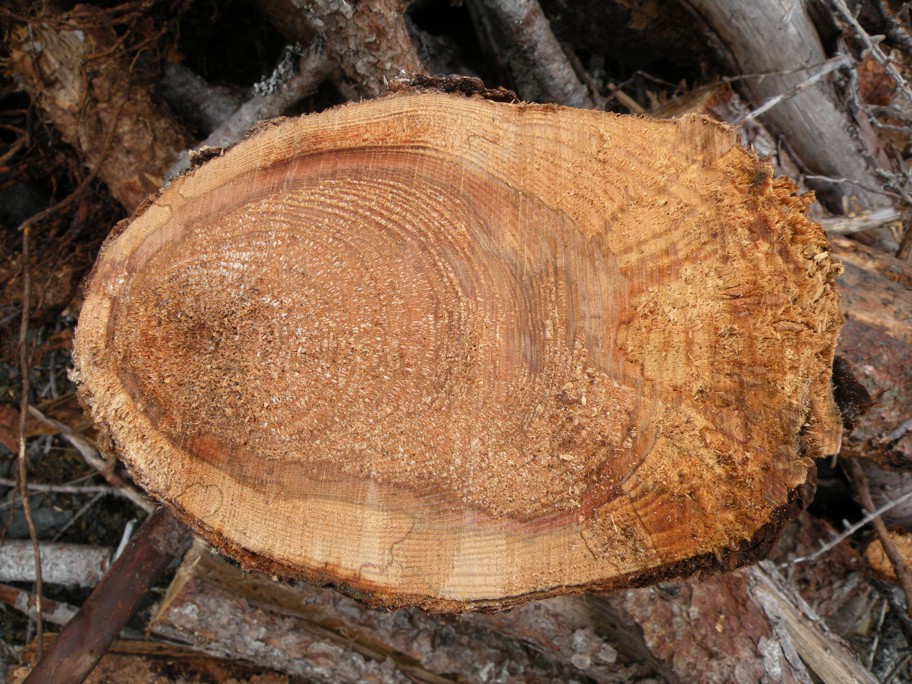
Tamarack heartwood and sapwood
I've been told that it makes an excellent firewood, even better than birch, although it can take up to 3 years to dry completely.  When it does dry, it is very hard and burns very hot.  Like yew, the wood has a dark orangish interior with tight growth rings, and a distinctly dark heartwood and lighter sapwood.  I think it might work for bow wood and since I'm going to be collecting it for future palaeoeskimo harpoons, I'm going to keep on the lookout for straight logs long enough for a Beothuk bow reproduction.

Typical snakey limb
The L'Anse aux Meadows harpoon needs to be completed and installed in a few weeks, so I won't have time to go from a fresh cut tree to a finished and dried reproduction.  I need to start with wood that is at least partly dry, if I have a hope of getting the project done on time without fear of future warping.

Lori's Mom and me cutting up windfall
Lori and I went to her parents cabin, about an hour out of St. John's, looking for deadfall to collect.  Lori's mom was a big help in pointing out a few trees that had fallen in the past 5 years, so they are at least partly dried.  We collected a few big logs and split one out there.  Lori wanted me to point out how its her and her mom helping saw up the lumber - her Dad and brother were in the cabin cooking and playing legos with her nephew.

Lori splitting the log
The wood is definitely a good match for the harpoon and when you knock on it, it seems very solid.  The plan is to bring these split staves into the basement, strap them to something flat and try to rapidly dry them out over the next few weeks.  Whether or not they are ready for the L'Anse aux Meadows harpoon, I'll at least have them on hand for future jobs.  I also collected a bunch of forked limbs that I can use as adze handles.
Hopefully one of these trunks will have a harpoon in it

Split tamarack
The wood we collected yesterday is plan "B", plan "A" is still to find a couple 5 foot long 2x4 sized pieces of already dried tamarack.  When we got back from the woods, I heard from a custom woodworker in the province who works with local wood and makes traditional Newfoundland furniture.  He has some on hand and is willing to help out.  I'm hoping that he'll have something that is ready to go that will also be a good match for the wood grain in the L'Anse aux Meadows artifact.

Photo Credits:
1,2,3,6: Tim Rast
4,5,7: Lori White
Related Posts with Thumbnails