Showing posts with label In-laws. Show all posts

Monday, May 3, 2010

The Hunt for Tamarack

L'Anse Aux Meadows Harpoon wood detail
I need some dried tamarack wood for the L'Anse aux Meadows harpoon reproduction.  Its a fairly common wood in the forests of Newfoundland, but its not a popular wood for lumber, so I didn't have any luck calling around to lumber yards in the city.  Its not a common building material, so it looks like I'll either have to collect and dry the wood myself or find a specialty woodworker who might be willing to part with some that is already dry.

Tamarack or Larch or Juniper
Tamarack is also called "Larch" and, in Newfoundland, "Juniper".  I'll probably use the term tamarack, because it seems to be the most widely used name for Larix laricina.  Its one of the hardest softwoods and unlike most coniferous trees it loses its needles in the fall.  Its pretty easy to spot from a distance at this time of year, because they are the naked evergreen trees, that grow with slightly snaky, twisty trunks.  When you get close they have little buds on the branches. 

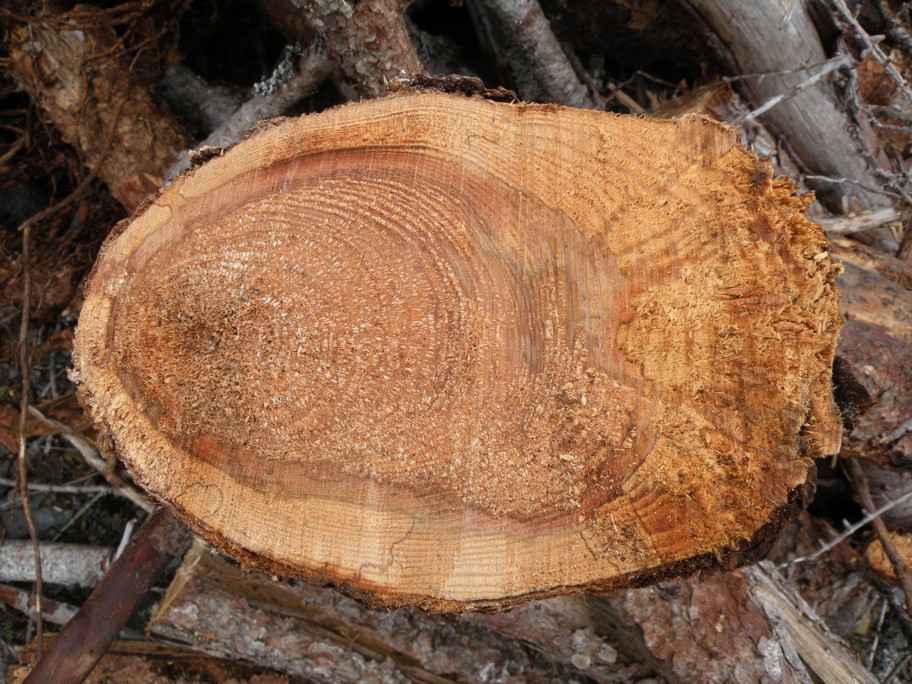
Tamarack heartwood and sapwood
I've been told that it makes an excellent firewood, even better than birch, although it can take up to 3 years to dry completely.  When it does dry, it is very hard and burns very hot.  Like yew, the wood has a dark orangish interior with tight growth rings, and a distinctly dark heartwood and lighter sapwood.  I think it might work for bow wood and since I'm going to be collecting it for future palaeoeskimo harpoons, I'm going to keep on the lookout for straight logs long enough for a Beothuk bow reproduction.

Typical snakey limb
The L'Anse aux Meadows harpoon needs to be completed and installed in a few weeks, so I won't have time to go from a fresh cut tree to a finished and dried reproduction.  I need to start with wood that is at least partly dry, if I have a hope of getting the project done on time without fear of future warping.

Lori's Mom and me cutting up windfall
Lori and I went to her parents cabin, about an hour out of St. John's, looking for deadfall to collect.  Lori's mom was a big help in pointing out a few trees that had fallen in the past 5 years, so they are at least partly dried.  We collected a few big logs and split one out there.  Lori wanted me to point out how its her and her mom helping saw up the lumber - her Dad and brother were in the cabin cooking and playing legos with her nephew.

Lori splitting the log
The wood is definitely a good match for the harpoon and when you knock on it, it seems very solid.  The plan is to bring these split staves into the basement, strap them to something flat and try to rapidly dry them out over the next few weeks.  Whether or not they are ready for the L'Anse aux Meadows harpoon, I'll at least have them on hand for future jobs.  I also collected a bunch of forked limbs that I can use as adze handles.
Hopefully one of these trunks will have a harpoon in it

Split tamarack
The wood we collected yesterday is plan "B", plan "A" is still to find a couple 5 foot long 2x4 sized pieces of already dried tamarack.  When we got back from the woods, I heard from a custom woodworker in the province who works with local wood and makes traditional Newfoundland furniture.  He has some on hand and is willing to help out.  I'm hoping that he'll have something that is ready to go that will also be a good match for the wood grain in the L'Anse aux Meadows artifact.

Photo Credits:
1,2,3,6: Tim Rast
4,5,7: Lori White

Wednesday, March 31, 2010

Preparing Seal Parts to Dry

Then things got weird
When I wrote last Friday that this past weekend would be a big change of theme for Elfshot, I meant I'd be switching to wholesale jewelry production, not that I'd be hanging up 85 feet of inflated seal intestines in my workshop to dry.

I missed some of the fun on Monday morning, so here's Lori's take to fill in the gaps between the DFO necropsy on the hooded seal and the backyard:

The soft parts of the seal in tubs
It was impossible to find an archaeologist with a pickup to help out with transport so my dad came to the rescue. He arrived the minute we finished packing up the seal and all the totes waiting in the loading bay. Dad likes to keep his truck in pristine condition (as you might remember) so I was thrilled he agreed to take on this potentially messy deed. He arrived with a tarp spread out over the box floor so all he had to do was back ‘er up to the loading bay and Eliza and I loaded the totes on board. Dad was also instrumental in getting the skeletal parts to MUN and into Eliza’s lab freezer, and later the sealskin and I back to my house. Of course, it didn’t hurt that he stuck around and allowed me to sit in his truck for a half hour while we waited for Tim to return from the wholesale show... in all my seal necropsy excitement I had gone off and forgotten my keys... No, this apple doesn’t fall far from the tree. A BIG THANK YOU TO DAD. XO

Cutting off sheets of fat
I did a bit more work on the cleaning the fat off the hide. The fat was still an inch or more thick in many places so it was still too early to start scraping. Officially, the fat layer was measured at 4.5 cm thick, but there were spots that were at least 6 or 7 cm thick. I was cutting off the fat in sheets. The word "gobbet" kept coming to mind as the smaller chunks of fat plopped into the blubber bucket. I'll try to figure out a way to weigh the fat today. I can't lift the container anymore.

Arm through left flipper hole
I'm still a novice when it comes to judging where the hide will be while cutting through the fat, so I found it safest to run my left hand along the outside of the hide while cutting with the knife on the inside. That way I could apply constant pressure to the skin and judge the thickness of the fat. In the photo on the left, my arm is through the hole where the seal's left front flipper was cut out. The hole around the right flipper tore and is the ragged edge on the bottom of the skin. The other small holes and nicks in the hide are accidental cuts from the skinning and blubber removal. Those holes won't matter much in the end, because I plan to cut the hide into a long thong about 3/4 of an inch wide.
The speckled pattern in the hide
I finally got a 1/4 or so of the hide down to the skin and it feels like when the whole hide is down to that level I can start scraping. That will probably be later today. The hide is spotty on the inside, so in the photo you can pretty clearly see that part of the pelt that is clean down to the skin and ready to be scraped.

Cutting the webbing around the intestines
We spent about half the day yesterday cleaning the intestines and bladder. Squeezing out the intestine contents was pretty gross; there were flaky bits coming out of the end attached to the stomach and baby-poo yellow paste coming out the opposite end. The 85 feet of intestine were sampled during the necropsy, so it was cut into three sections. There is a connector webbing that pulls the intestines into a coiled mass and that needed to be cut in dozens of places in order to stretch them out straight.
Tying off the inflated intestine
After I squeezed out each section and ran water through them we inflated them with a mattress pump so that they can dry. We hung the inflated tubes up in my workshop to dry. On the best of days, my job is a little unusual, but stringing those rubbery tubes up in the shed was weird even for me.
I'll be sitting under this all spring
I don't have an immediate plan for the intestines, but once they are dried out they will make a tough, lightweight, waterproof, translucent kind of parchment. They were used in the Arctic for windows in snow houses and waterproof clothing. There are some beautiful, light weight anoraks made from strips of intestine sewn together. Check out this site, Seal Gut Raincoats, for more info.

Hooded Seal Bladder
Finally, we inflated the bladder and hung it up to dry. The bladder was cool - the sphincter muscle is still springy and strong enough that when you pump it up it closes tightly enough that it holds the air in. Its like a balloon that seals itself when you inflate it. These things were used for floats on harpoons and water containers.

Photo Credits:
1-4,6-8: Lori White
5, 9: Tim Rast

Friday, April 3, 2009

Working at Home, Living at Work

So I have a brand new hot water boiler and a house full of in-laws this morning. In between all the boiler and family excitement yesterday, I assembled and carded a few obsidian and glass necklaces and earrings. I also had a good chat with a woman in Corner Brook looking for a few complete artifact reproductions as well as pieces suitable for a sandbox dig. This is another opportunity to make use of Cultural Products seconds.

Lori's mom was staying with us a couple of nights this week and noticed that our hot water was a slightly more yellow color than our cold water. Our hot water boiler is 7 years old and Lori has been keeping an eagle eye on it for the past 3. We finally got some discolouration in the water so we decided to replace it before it completely let go and flooded our basement.

Lori's parents have a good friend in the plumbing supply business and he gave us a deal on the tank and set us up with a reliable, cheap plumber to install it. Lori's dad was in town with his truck, so he could pick it up for us, no problem. Unfortunately, when he went to restart his truck after popping into the warehouse to get the boiler it wouldn't start. His official explanation was that water from the car wash must have shorted out the starting motor. This was controversial enough for his wife to hear, because she thinks he has a carwash addiction and doesn't need to wash the truck multiple times a week. Later in the day, when Lori's mom was out of the room, he wondered if opening up the hood to shampoo the engine and blast it with the pressure washer might be the real culprit.

So, the truck is in the garage and in-laws are in the basement.

That pretty much sums up the pros and cons of working at home. Its convenient to be able to be around when the plumber needs to show up. But the distinction between home life and work life is pretty blurry. To people on the outside it can feel like you are always at home, while to you it can feel like you are always at work.

Photo Credit: Tim Rast

Photo Caption: Obsidian jewelry from Elfshot.
Related Posts with Thumbnails