Showing posts with label Harpoon. Show all posts

Tuesday, April 2, 2019

Maritime Archaic Reproductions for Port au Choix

Bird headed pins made from caribou long bones
and needles made from bird bones and caribou ribs.
This is a set of reproductions that I recently completed for Port au Choix National Historic Site on Newfoundland's northern peninsula.  The set includes a hafted ground stone axe, slate lance, barbed harpoon, bird headed pins and bone needles.  Some of these are newly made and others are pieces that I've had in stock and that I've shown on this blog before.

The pins and needles have been slightly antiqued to take off the fresh white bone sheen.
 
Some of the needles have flat cross-sections and are made from bird bones and others have round cross-sections and are made from caribou ribs.  All of them have gouged eyes and they range in length from 5-11 cm.

Often when I make these pins, they are intended to be used as hair pins with sealskin barrettes.  However, the ones in this photo are intended to be used in display and public programming, so I was able to show more of the variety in the actual pins and pendants and not just the long pointy pin versions.  Many of the bird headed bone carvings at Port au Choix adorned shorter pendants, with gouged holes in the shaft opposite the bird head.  Presumably these were used as pendants or hung from clothing.
 
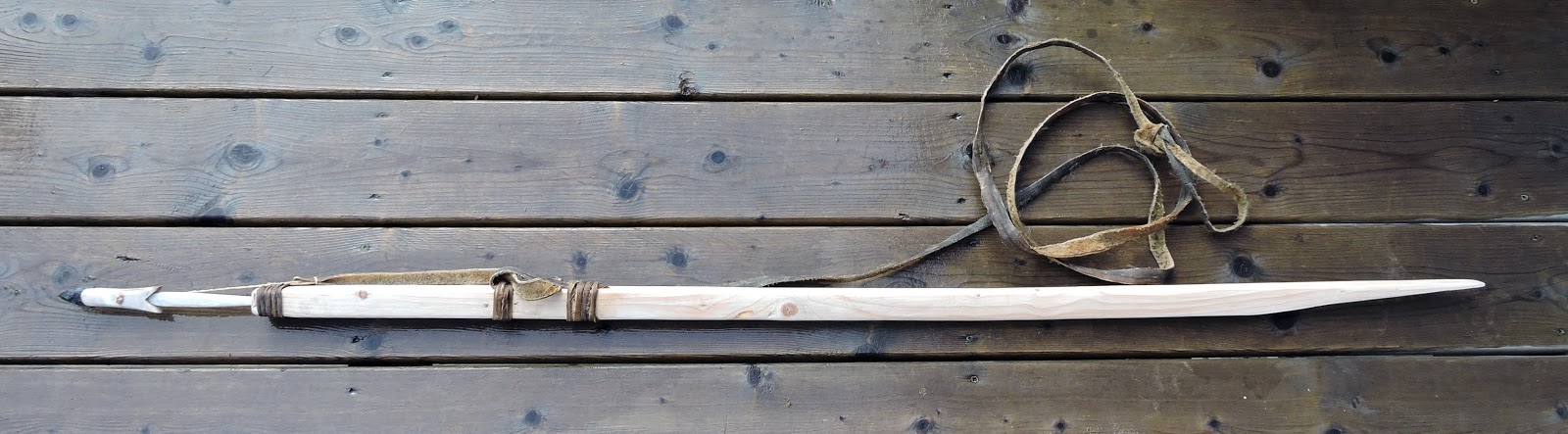
The larger, hafted pieces in this set include a ground slate (or argillite) axe hafted into a wooden handle. The axe head is secured with pitch in the hole in the wood which was burned out with hot coals.  The rawhide lashing is there to reinforce the handle and prevent it from splitting in use.  The harpoon in the middle has a barbed antler harpoon head with a whalebone foreshaft and spruce main shaft.  The slate lance is hafted to a wood shaft with spruce pitch glue and gut lashing.

Ground slate lance head.  The lancehead is about 22 cm long, which is on the large end of the spectrum for Port au Choix.

The harpoon is covered in red ochre. The Maritime Archaic certainly covered their bodies and tools with red ochre as part of their burial ceremony, but it is unclear if they used ochre as frequently in day-to-day life as the later (and unrelated) Beothuk.

This style of harpoon head is not designed to toggle, although the Maritime Archaic did also make toggling harpoon heads.  The barbs would have secured the harpoon head and line to the prey animal - most likely seals.

The harpoon line is braided sealskin.  The harpoon is about 72" fully assembled and the lance is about 92".  I don't know how long the main shafts of the Maritime Archaic versions of these tools would have been.  Generally the tool components are larger than the later Dorset and Groswater Pre-Inuit who lived in Newfoundland, so I tend to make the overall reproductions larger and longer as well.
 
The lance is fixed to the wood shaft.  I envision these long straight sided lances as close range piercing tools, especially for penetrating the thick blubber layers of marine mammals.  A fixed lance head could be stabbed and pulled out repeatedly.  The harpoon head, on the other hand, is designed to detach and stay in the animal with a line attached.
Photo Credits: Tim Rast

Monday, July 17, 2017

Provincial Historic Sites Reproductions and Games

Red Ochre stained Beothuk
knife reproduction
Last week, I delivered an order of artifact reproductions and games to the folks at Provincial Historic Sites to use in interpretive programming.  One set was a collection of Beothuk hunting tools, including a knife, scraper, deer spear, harpoon, and three arrows.  A second batch of games included rawhide buzzers, a waltes set, and pin-and-cup games.
The harpoon and deer spear (lance) are
very hard to photograph because of
their length.
Some of these pieces are new to me, including the Beothuk lance.  I used the archaeology site at Russell's Point as the reference collection for the lithics in the collection.  The knife blade, end scraper,  arrowheads, and lance head are all based on artifacts found by Bill Gilbert in his MA research at Russell's Point.  I used a metal endblade on the harpoon because I've only seen metal endblades on Beothuk examples of that implement.  It's possible that some of the lithic artifacts that we find in Beothuk sites and classify as arrowheads or triangular bifaces were used to tip harpoon heads, but no one has found one in association with a harpoon head to prove it.  Here's a link to a blog post from 2014 where I discuss the references available for Beothuk harpoons and deer spears.

Beothuk harpoon and lance reproductions

The point of this lance is based on a large bi-pointed artifact found at Russell's Point.  It's possible that it was an unhafted bifacial knife, but it was symetrical enough that it's possible that it tipped a long deer spear, similar to the long iron tipped deer spears of the later historic period.

An antler harpoon head with a steel endblade and sinew lashing.  Like all of the Beothuk reproductions that I make, it is covered in red ochre.  The harpoon head has a line attached and is designed to slip off the end of the long wooden harpoon shaft when it is stabbed into a seal.

The complete harpoon and lance.

According to historic observations and drawings by Shanawdithit, the harpoon and dear spear were very long.  The deer spears were reported to be 12 feet long, while harpoons were variously reported as 12-14 feet long.  The one shown here is 13 feet long and the deer spear is 12 feet long.  These tools are so lengthy, that I make them in two pieces with a hard raw hide socket to join them together.  The can be taken apart for transportation and storage and reassembled for interpretation.

Beothuk style chert knife in a wood handle with sinew lashing and red ochre staining.

Hafted endscraper.  The endscrapers at Russell's Point were primarily made on flakes and had very rounded scraping edges, especially when compared to similar Palaeoeskimo artifacts from Newfoundland and Labrador.

Wood artifacts are very rare form Beothuk archaeological sites.  There are a handful of pieces from ethnographic contexts, but things like tool handles are very hard to come by.  When I don't have archaeological references to use, I try to fill in the blanks as simply as possible.


Beothuk arrow reproductions.  Chert, sinew, pine, goose feathers, red ochre

The Beothuk reproductions together.

Raw hide buzzer game
A buzzer in action. You can do the same thing with a big button twisted on a string.  It sounds like the wind when it whirs.

Bone and antler pin and cup games.

Success!

Waltes.  This is a Mi'kmaq game.  There are many examples of this game in the Maritimes and it's becoming popular among the Mi'kmaq of Newfoundland.  The game is played with a shallow wooden bowl and six game pieces.  The game pieces are blank on one side and incised with a design on the other and the game is scored based on the combination of face-up and face-down dice when they are flipped in the bowl.  The sticks are used for scoring.  Provincial Historic Sites tried unsuccessfully to find a Mi'kmaq craftsperson in the Province to make this game set before coming to me.  It would be good to see someone from the Mi'kmaq community making these.


Photo Credits: 
1-6, 8-10, 13, 15-17: Tim Rast
7, 11, 12, 14: Lori White

Thursday, December 8, 2016

Sicco Harpoon Head and Dorset Harpoon

Sicco Harpoon Head; antler, slate, sinew
I finished and shipped these pieces recently.  The harpoon head is a Sicco and the harpoon is Dorset Palaeoeskimo, based on artifacts found in Newfoundland and Labrador.  The Sicco harpoon head is made from antler, sinew and slate.  We chose antler for this piece over walrus ivory partly to keep costs down and partly to prevent problems at the border.

Dorset Harpoon; chert, antler, whalebone, wood, sealskin, sinew

The spare foreshaft is made from antler.  I prefer whalebone for foreshafts because they are not affected by humidity in the same way that antler is.  Antler will swell and bend in changing humidity. Whalebone is stable in all conditions.


Photo Credits: Tim Rast

Friday, June 10, 2016

Newfoundland Harpoon and Arrow Reproductions

The pointy ends of harpoon and arrow reproductions
I completed a set of artifact reproductions based on artifacts found in Newfoundland and Labrador this week.  The set included a complete Groswater Palaeoeskimo harpoon, a Dorset harpoon head with a tip-fluted endblade, a barbed Maritime Archaic harpoon head, and a Beothuk or Little Passage style arrow.  These pieces are on their way to Nova Scotia right now and will be used by an archaeologist friend of mine in school talks.  
 

The set is intended to represent four different cultures and illustrate some of the different technologies used in the pursuit of food over time.  The complete Groswater harpoon can be used to demonstrate how a toggling harpoon works.  The small Dorset harpoon head fits onto the whalebone foreshaft on the Groswater harpoon, although it lacks an harpoon line.  The barbed Maritime Archaic harpoon head belongs to a completely different time period and cultural group so it isn't compatible with the Palaeoeskimo harpoon.  It shows a contrasting technology that would have been used for the same purpose; hunting seals.

I modeled the main shaft of the harpoon on the wooden harpoon shaft found at L'Anse aux Meadows.   
The Groswater harpoon, with it's distinctive harpoon head and endblade in place.

Ochre staining the Maritime Archaic barbed harpoon.  Unlike the Palaeoeskimo harpoon heads with a line hole centered in the middle of the harpoon head, this style of harpoon head has a single line hole positioned close to the base.  It relies on the barbs for gripping the seal and won't toggle in the wound the same as the Dorset and Groswater harpoon heads.
Another view of the Groswater harpoon head with a shelf cut on one side and lashing holes gouged through the nose to tie the plano-convex, box-based endblade in place.  The endblade is knapped from local Newfoundland chert, the harpoon head is antler, the foreshaft is whalebone, and the mainshaft is wood.  Sinew and sealskin are used to tie the various pieces together and to create the harpoon line.
 
Side views of the reproductions.  From left to right, Maritime Archaic harpoon head, Little Passage Arrow, Dorset harpoon head, and Groswater harpoon.
 
Dorset harpoon head made from antler with a tip-fluted chert endblade.
 Photo Credits: Tim Rast

Monday, February 29, 2016

How-To Care For Your Thule Harpoon Reproduction

This blog post is for the folks at The Manitoba Museum who will be receiving this Thule Harpoon reproduction in the mail in the coming days.  The harpoon has several moving parts and there will be some assembly required.  I'll walk through that assembly in the second half of this post.   I work several of the materials used to construct the harpoon while they are wet (sinew, sealskin, and whalebone) and I try to let them dry naturally on their own before I ship them.  I do use foam and bubblewrap to protect some of the objects in the package, but I also use a lot of paper and cardboard to let the material breath and allow any remaining moisture to seep out.  

Still, it would be a good idea to open up the package soon after it arrives to reduce the chance that any mould or mildew will grow where any remaining moisture might be trapped.  There is also a healthy coating of mineral oil over all of the surfaces to help keep the moisture and humidity sensitive components, like the wood and walrus ivory, from gaining or losing moisture too quickly as the harpoon travels from the coast to the interior of the continent.  If anything starts to dry out over the coming years, a periodic application of mineral oil will help prevent cracks from forming in the wood and ivory.  
The harpoon foreshaft is held in place with a braided sealskin cord.  This cord will also stay stronger and more pliable if it is kept damp with mineral oil.  I use unscented baby oil.  When the harpoon arrives you will need to rotate the foreshaft into it's socket so it looks like the image on the right.  It should be a fairly snug fit.  You can adjust the fit by tightening or loosening (shortening or lengthening) the leather cord.  The cord winds it's way through two holes in the whalebone foreshaft and four holes in the wood main shaft.  Sliding the cord through these holes will change the tension in the fit between the foreshaft and the whalebone socket.

Near the middle of the main shaft you will see an ivory finger rest which is there to prevent the hunter's hand from sliding along the harpoon when it is thrown with mitts on.  It is tied in place with twisted sinew thread.  Near this is a small whalebone hook that is inserted into the side of the harpoon shaft.  This hook is designed to fit on to a whalebone tension piece that is sewn on to the sealskin harpoon line with sinew.  

When you assemble the harpoon, the harpoon head will be held firmly in place on the end of the foreshaft when this tension place is slid over top of the hook as shown in the photo on the right. The tension piece has two holes because the sealskin line will change length depending on whether it is wet or dry.  The line shrinks when it is dry and you will need to use the far hole on the tension piece.  The hooded sealskin line that I used is very tough and you may need to rotate the foreshaft in the socket a few degrees to allow enough slack in the line to fit the harpoon head onto the foreshaft and lock the tension piece onto the plug.


If you rotate the socket a few degrees you can get enough slack in the line so that you can lock the harpoon head and tension piece in place.


When the foreshaft is straightened out again the harpoon head will be firmly secured to the harpoon and the only way that it will detach is if the foreshaft rotates in the socket again and allows slack in the line.  The force from the impact when the harpoon is thrown is designed to cause the foreshaft to buckle and rotate in the socket so that the harpoon head will detach and toggle in the wound.

 Every component and joint in the harpoon is custom made and individually fit together.  On this particular harpoon, you will notice that the harpoon head fits better one way than the other on the foreshaft.  The harpoon line is also very affected by moisture.  If you find it impossible to secure the line to the harpoon using the tension piece, then you can soak the line in warm water for a few minutes and it will soften and length to a point that you can easily slip it in place.  If it is completely soaked, you may notice that you need to use the second hole in the tension piece in order to secure the harpoon head in place.

The wood and whalebone components will be the most durable parts of the harpoon.  Whalebone was used for the foreshaft, foreshaft socket, the tension piece, and knob.  Ivory is hard, but sensitive to light and humidity.  Storing or displaying it in direct sunlight will cause it to crack.  The harpoon head, finger rest, and butt of the harpoon are made from walrus ivory.  The sinew is tough, but sensitive to moisture, if you soak the harpoon line in water, then the sinew lashings on the tension piece will expand and may come loose.  When they dry again they will tighten.  The sealskin line works best when it is slightly damp, either with water or mineral oil.  When it dries out it can crack if you try to bend or force it into a new shape, but when it is damp it is strong and flexible.  The slate is thin and sharp and is one of the more fragile materials on the harpoon. Be careful about lying it down on hard surfaces or knocking it on doorways.  The slate endblade is relatively quick and easy to replace if it becomes damaged, but use caution in handling it.


The fully assembled harpoon.

 Photo Credits: Tim Rast
Related Posts with Thumbnails