Showing posts with label Memorial University of Newfoundland. Show all posts

Monday, November 16, 2015

ARCH 4153 Lithic Analysis at Memorial University of Newfoundland


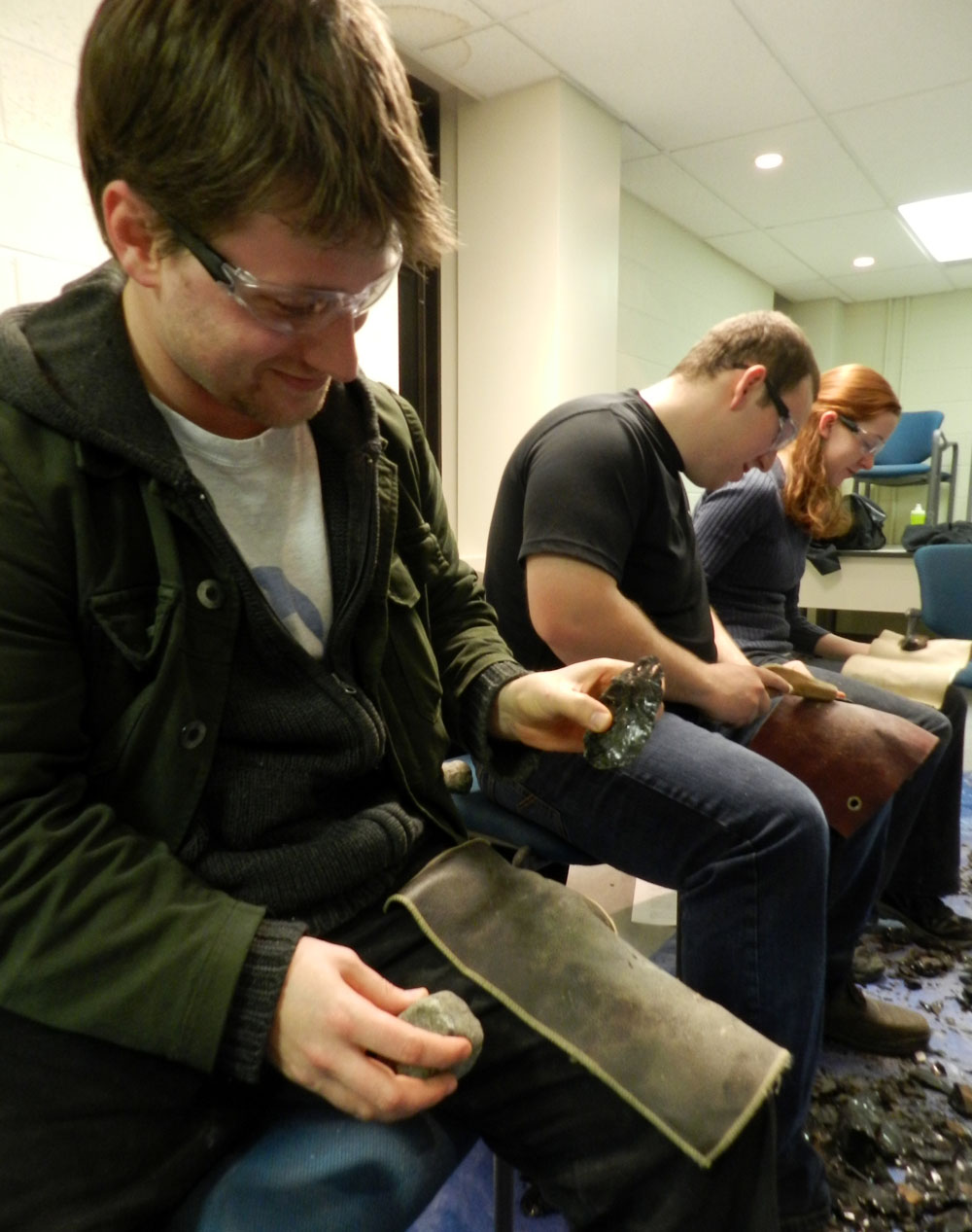
I'll be teaching ARCH 4153 during the winter semester through the Department of Archaeology at MUN.  This course is offered every second year and we will cover many topics that will help archaeology students as they continue on an academic path or look for work in the consulting world.  A strong working knowledge of stone tools, from their manufacture and use to the meaning behind their distribution within a site or across a region, is an important skill for any archaeologist.  Space is limited, register today.

Photo Credit: Tim Rast

Wednesday, November 5, 2014

Elfshot News

Flintknapping for Arch 2480
Earlier this week I did a flintknapping demo at Memorial University of Newfoundland for the Archaeology 2480 students.  The instructor, Amanda Crompton, took this photo and submitted a brief write-up to the department website, which you can view here: Archaeologist Tim Rast demonstrates flintknapping techniques to students.  If you're in St. John's you may recognize Amanda's name because she is giving an NLAS talk at The Rooms next Wednesday evening (Nov 12, 7PM) called "FINDING THE CHAPEAU ROUGE: THE HISTORY AND ARCHAEOLOGY OF FRENCH SETTLEMENT IN PLACENTIA BAY BEFORE 1720", and if you're a member of the Canadian Archaeological Association, then you may recognize Amanda's name as the Conference Chair of the 2015 CAA Conference being held in St. John's at the end of April.  

Me and my camera
Speaking of the CAA conference, I have some overdue news to report from the 2014 Conference held in London, Ontario.  I won a Canadian Archaeology Association YouTube Award! Its for the video clips that I made last spring talking about the Dorset Palaeoeskimo drum reproductions and the sequence of markings that adorn the drum frame.  I was nominated by Matt Betts and the award was sponsored by the Canadian Museum of History.  I wasn't able to attend the conference for the announcement or to receive the prize, which was waiting for me in a pile of post-fieldwork and post-Italy mail.  The awards committee let me know about the prize shortly before the conference, which was when I was gearing up for the field, so I pre-emptively spent the prize money on a new camera.  It seemed appropriate, since my last camera died while I was visiting the Canadian Museum of History in the spring to research the Dorset drums.  I bought a Nikon Coolpix P600 and I've used it to take almost all of the photos shown on this blog since June. 


Photo Credits:
1: Amanda Crompton
2: Lori White

Friday, January 31, 2014

Knapping with future lithic analyists

I had a good day with archaeology students at Memorial University of Newfoundland today.  I spent the morning with Catherine Jalbert's lithic analysis class and ended the day with a student mixer where I was helping represent the Newfoundland and Labrador Archaeological Society.  During the morning class, we covered percussion knapping and we will be continuing with pressure flaking next week.

For MUN students who are interested in knapping it looks like MUNArch will be offering the flintknapping workshops again this semester.  We're finalizing the dates and topics, but it should happen late February/early March. Stay tuned for details.


Photo Credits:
1-2: Tim Rast
2-4: Catherine Jalbert

Wednesday, December 11, 2013

Boxing up Flintkapping Kits

Each kit has a copper pressure flaker,
leather palm pad and an instruction
booklet
During the winter semester, a friend is teaching a Lithic Analysis course in the Archaeology Department at Memorial University of Newfoundland and the students will be expected to try flintknapping for themselves.  I don't think you have to be a master flintknapper in order to study stone tools, but knowing the basics will help put everything into context.  I've spent a few hours this week packaging up some knapping kits for the students.  I've been invited to make a couple classroom visits where I'll help them get started and in the meantime they will have some of the basic tools to practice with.  It also looks like I'll be doing some workshops, talks, or demos in western Canada again this winter or early spring.  I'll post more when the details are sorted out, but it looks promising and will probably include some cities that I haven't knapped in before.

Ready to Deliver
Photo Credits: Tim Rast

Monday, April 29, 2013

Plans and Profiles: Frédéric Dussault Researching the Archaeoentomology of Dorset Palaeoeskimo Sites in Newfoundland

Frédéric Dussault in a still standing sod house in
Qaqaitsut, Greenland. Photo: Erika Sakrison.
Frédéric Dussault is a PhD student in the Archaeology Department at Memorial University of Newfoundland who is studying northern cultures in a rather novel way; he is examining the insect remains found in archaeological sites to reconstruct past environments and people's lifestyles.  Many types of insects occupy very specific environmental niches and so by finding and identifying those insects in an archaeological context researchers like Frédéric can tease our clues to the past plants, animals and humans that once lived in an area.  


Plans and Profiles #15. Frédéric Dussault, Archaeoentomology on Dorset Palaeoeskimo sites in Newfoundland


1) Tell me a little bit about your project.

I am still in my first year of the PhD program at MUN and I will be undertaking my first field season for my research this summer, but I will try to summarize it as much as I can.

Animal ectoparasites can be used as witness to
the presence of the animal. The picture is a
dog louse that i recovered from samples from
Dogs Island in Labrador (HeCg-08).
Over the course of the next years, I intend to study the sites of Port au Choix and Stock Cove using different environmental proxies that I will recover from soil samples taken on both sites. More specifically I will be working with insect remains, as well as macro and micro botanical remains, such as seeds and pollens. I will be examining these previously neglected data in order to develop a comprehensive, holistic model of the settlement selection pattern of the Dorset in Newfoundland. The environmental proxies that I chose for the analysis will allow me to better our understanding of the Dorset impact on the environment of Port au Choix, but also examine alternate economic sources of the Dorset. Finally, over the course of my research I will attempt to assess the role of women, children and elders in the Dorset culture (genders, non-biological, cultural construct).


2) How did you become interested in this particular problem?

Picture of the Cape Grinnell site in
Greenland, where I worked on Inuighuit
structures for my MA.
I can't remember precisely how it came up, as it is the result of a reflection taking place over years while I was in the field and while finishing my master's degree at Université Laval. Since the BA I was interested in environmental archaeology and more particularly archaeoentomology. However, I came to realize that very little work had been done on the different arctic cultures, except maybe the Norse in Greenland. Archaeoentomology was not the only subject that was barely applied on arctic and subarctic site, the same applied to archaeobotanical analyses. At some point, I finally read an article by Cynthia Zutter, where she reviewed the use of plants on Thule sites in Labrador. This article made me wonder why would the Dorset in Newfoundland, a usually high arctic culture, not take advantage of this really different environment. Zutter's paper made me realize that there is more to Dorset population than architecture, bones and artefacts.


3) What would be the best case scenario for your upcoming season(s) of fieldwork?

Human louse found in samples from the Cape Grinnell site.
The field season will start at Port au Choix and I hope to be able to go to Stock Cove too. Going to both sites this summer would be great. It would allow me to sample the natural environment around the sites, as well as any structures or middens that will be excavated. I would then be able to start the treatment of the soil samples and  the identification of remains as soon as possible. I hope to build a reference collection of beetles found near the sites during the field season. It will inform about the local insect species and help in the identification of insect remains. So, first, I hope I’ll be able to sample both sites and, second, I hope for nice weather and a buggy summer ! The crew is probably going to hate for the buggy part....


4) If you could ask the people who lived at your site(s) one question what would it be?

That is a good one. I think I would ask them how they perceive their environment, what do they think of the forest, the landscape and even how do they feel about the insects around them. During my MA, I read about the oral tradition of the Greenland Inuits and I became fascinated with it. It is so rich and full of information about the perception of insects and the relation past humans had with them. I would like to know if the Dorset simply hated insect or if they had a use for them? Are there stories, myths or legends relating to the different insects, what was their role in the myths and stories ? I probably would end up asking them about their food, I love to know what people eat and know how they prepare it.

Whale bone comb that was found during the field work in Qaqaitsut, Greenland, the second site I was studying for my MA.

5) Why did you choose Memorial University of Newfoundland?

Although we were at Cape Grinnell to excavate Inughuit
houses, we had the chance to dig older houses,
such as this Indepedence I structure.
The first reason that comes to my mind when I think of why I chose MUN is for my advisor, Dr. Renouf. Many of my past collegues hold her in really high esteem and recommended working with her. During my MA, I knew about the Dorset culture, but they never were the focus of my research in Greenland. Following email exchange with her and conversation with professors in Université Laval, I became more and more intrigued with the Newfoundland Dorset population. The site of Phillip's Garden has been studied for so many years now that some might think that there isn't much left to learn about the site, but I thought quite the opposite. The site is unique and the quantity of information available from previous research is astonishing, but very little environmental archaeology has been done on the site. I thought it would be an ideal place to begin environmental archaeology in Newfoundland ! Lets add another layer of information to this very well known site !

The second reason why I chose MUN is the community. Over the last couple of years, different students from Laval and other people I know who have been coming over here for their research only gave positive feedback. Right from the start, when I met people from here and when I arrived last fall, I already felt at home. People are kind and really helpful.


6) How do you unwind when you need to get away from your research?

It depends. There is a lot of different ways I spend my downtime. One of the first things is videogames, either on the computer or on the PS3. They really allow me to disconnect completely from my research and everything related to it.

I also spend a lot of time in the kitchen. I used to be a chef and, even if I stopped cooking professionally and started school all over again, cooking remains a passion for me. Making good meals, spending time around the table with a good bottle of wine (or beer !), good food and friends are things I really enjoy. When I start cooking, I never know what will happen since I rarely use a recipe. I always end up with food for an army and having way too many leftovers.

Some people are obsessed with shopping for clothes or shoes. I my case, it is food. I always get excited when I discover new spices, new products and ways to prepare food. Finding a good bakery that makes the perfect loaf of bread or croissant is a moment of pure pleasure for me.


7) Do you have any lucky objects, functional or otherwise that you always take into the field with you?

Inughuit house that we excavated at Qaqaitsut in Greenland.
I don't have any lucky objects that I bring on the field. However, I bring books from the Wheel of time series every field seasons. It started in Greenland because a friend of mine lent me two of the books for the summer. Since then, I always bring two of them with me. I also bring insect identification field guides since you just never know what you might stumble upon!


8) What archaeological discovery or project do you wish you could have been part of?

I would have to say the mummies of Qilakitsoq. Since the end of my BA and all through my MA, the book The Greenland Mummies has always been on my desk. At first, I was interested by the entomological studies that they did on the bodies, but after reading the book, I was just amazed by how well they were preserved and how exceptional these find were.


9) What books or websites would you recommend if people want to learn more about your area of interest in general? Or your project in particular?

I think that the site of Port au Choix is well known and there is a lot of literature about this exceptional site, such as The Cultural Landscapes of Port au Choix Precontact Hunter-Gatherers of Northwestern Newfoundland. The introductory chapter, by Renouf (2011) gives a very good idea of the archaeological site, as well as the history of archaeological research.

Coleoptera (beetles) form the main body
of the insects we find in the samples.
Elytron of a Latridius minutus group
 found in a sample from the House B on
the Great Caribou Island, Labrador
(FbAv-13).
However, I know from experience that, when I am discussing my project and what exactly I do, most people are more intrigued by the archaeoentomology. It is normal as it is not a very well known science. If people are interested in learning about archaeoentomology, I would recommend Scott Elias Advances in Quaternary Entomology (2010). This book is a must-read if you are interested in archaeoentomology, the history of the discipline, the methodology and many other things. You should read it ! Otherwise, there are many different papers that have been written on the subject of insects and archaeological sites. For those who would be interested in pushing the subject farther, there is the website of Phil Buckland (http://www.bugscep.com/) which not only offers a nice program to help in archaeoentomology, but also a very up to date bibliography about archaeoentomological science (link to bibliography http://www.bugscep.com/qbib.html).

Elias, S. A.
2010. Advances in Quaternary Entomology. Development in Quaternary Sciences 12. Elsevier, Amsterdam.

Renouf, M. A. P.
2011. Introduction: Archaeology at Port au Choix. In The Cultural Landscapes of Port au Choix Precontact Hunter-Gatherers of Northwestern Newfoundland, edited by M. A. P. Renouf, pp. 1-21. Springer, New York.


===============================================

Can I interview you about your research? Perhaps you have a student or colleague whose work you feel should be profiled.  Please get in touch elfshot.tim@gmail.com.

Photo Credits:
Frédéric Dussault unless otherwise noted in the captions
Plans and Profiles Banner, Tim Rast based on a linocut by Lori White

Wednesday, March 27, 2013

MUNArch Flintknapping, I want more...

Last night's pressure flaking group
We're halfway through the MUNArch flintknapping workshops and I can't say enough good things about the student society for taking the initiative to organize these sessions, order the rock and fill the seats.  They're doing the heavy lifting and all I have to do is show up a couple nights a week and hang out with a cool bunch of folks chipping rocks.  In a workshop, I can handle groups of 15 people at a time and this year MUNArch has rounded up enough people to fill two 15 person sessions each week, with more waiting to get in.

Liz's pressure kit and finished pieces
For today's post, I was originally going to put up pictures of owls and elk from my trip to Alberta a couple weeks ago, because recently it seems like every time I put archaeology or Elfshot related musing up on the blog it turns into actual work for me to do and birds and deer seemed pretty harmless in that regard.  I'll save those photos for another day and take a gamble with a few ideas to expand the MUNArch flintknapping workshops in the future.  Even if nobody else reads this stuff, I know that I refer back to these comments and idea posts the next time I'm asked to lead a workshop, so here goes...

Trial, error, luck and talent - in no particular order.
This year we are running two concurrent 15 person workshops on Tuesday and Wednesday evenings for three weeks.  In week 1 we learn hard hammer and soft hammer percussion,  in week 2 we cover pressure flaking, and in week 3 we will be hafting our work from the first two sessions.  I think it works well as a three week series of workshops and one possibility is to switch up the third week activities every year that its offered.  We could easily substitute ground stone ulus for the third week or make the hafting session focused on a particular tool type (ie. everyone makes arrows or scrapers).  Since its an archaeology crowd, we could make week three a little more scientific and play around with usewear by cutting, chopping and scraping different materials with our tools and flakes and looking at them under the microscope to see the different polish and damage that forms.  We could also spend that week looking a little more specifically at reduction strategies for percussion or pressure flaking.   Knowing how to take a flake off is one thing, but being able to plan the sequence of flake removals so that they lead to something that you want to make is another thing.  I'd also like to try the Goat game that Jason Roe played with a group during the Calgary workshop, where everyone sits in a circle and takes turns working on a single biface, one flake at a time, until its finished or it breaks.

We're working primarily obsidian.  Pressure flaking gives you a lot of control over the final form.  I was taking lots of photos of finished pieces last night - I think these are Brittany's, but correct me if I'm wrong.


Bryn's first biface
Another alternative would be to find a way to combine all of these things into a course that runs for more than three weeks.   We could easily add an extra week or two next year to cover more ground.  It could even work as a semester long adult education course (if MUN still had adult education courses) or as the lab component of an archaeology lithic analysis course.  If it was a lithics class that students could enroll in for credits, then we could add a few bags of artifacts at the end for some practical experience in cataloguing and analyzing a small collection of lithics, to give the students a chance to put their understanding of stone tool manufacture to work.  I think that I could handle more than 15 students in the hands-on lab part of such a course, if some of the theory was explained ahead of time in a classroom setting.  Right now I spend a small amount of time explaining what we are doing at the start of the evening and then spend a lot of time going around the room helping people one-on-one, but if there was more time spent up front explaining the process, I think people could be a little more independent and require less one-on-one attention as they work and experiment on their own.

Ian's handaxe
I just wanted to jot down those ideas while they were on my mind.  There's plenty of time to forget them in the next twelve months if I don't make a note of them now.

Photo Credits: Tim Rast


Friday, February 22, 2013

Plans and Profiles: Dominic Lacroix Researching Maritime Archaic Indian Landscapes and Collections

Dominic Lacroix visiting the
multi-component site of
Stock Cove, eastern Newfoundland
(photo by John Erwin 2010)
Dominic Lacroix is working towards a PhD in Archaeology at Memorial University of Newfoundland. He's trying to make sense of the Maritime Archaic Indian presence in Newfoundland through the artifacts that they left behind and by reconstructing the landscape that they occupied.  Its cool work, and whenever Dominic speaks about his research I try to listen.  Now, after reading his responses to the Plans and Profiles questions, I look forward to reading about his efforts as well.  You don't have to be an archaeologist to appreciate Dominic's search for answers to his many questions about the Archaic period in Newfoundland, so pour yourself a coffee, get comfortable and enjoy...


Plans and Profiles #10. Dominic Lacroix, Maritime Archaic Indians in Newfoundland

1) Tell me a little bit about your project.

A variety of objects dating to the Archaic period from
 various regions of the island. (photo by Dominic Lacroix 2013)
My project focuses on the very first Newfoundlanders, a group of Amerindians we call the Maritime Archaic Indians (MAI) that settled and made the island of Newfoundland their home for thousands of years starting some 6000 years ago. Although a number of amazing sites dating to this time period have been excavated on the island, we actually know very little about these people in contrast to other groups that have since followed in their footsteps. Through my research, I’m attempting to flesh out our understanding of what it was like to live on the island of Newfoundland so long ago, in a world very different from our own. To do so, I blend artifact analyses with historical and palaeoenvironmental data, and computer models to explore notions of group identity, homeland, mobility, and interaction amongst various Archaic communities. In contrast to other Archaeologists you’ve featured so far in your Plans and Profiles, my project does not rely on an excavation program. Instead of focussing on a single site, I’m interested in the big picture, landscape patterns present at the scale of the entire island. So for my project, I’m relying on data that already exists, whether it is to be found in digital form, in historical records, or as items now curated in various local, provincial, and federal collections.

An important aspect of looking at the big picture is putting all the information we have in its proper historical and cultural context. One factor strongly affecting our understanding of the Archaic is sea-level change, which has had a dramatic impact on certain coastal regions of Newfoundland over the last 6000 years. To use an example right out of Tim’s MA thesis, the sea has risen by more than 10 m along the south coast since the Archaic. The coastal landscape people would have inhabited in this region is now almost completely submerged, except for high points which are now islands. In contrast, the Northern Peninsula has been rising out of the sea over this same period, so Archaic coastal sites in this region are now hundreds of metres inland, like the Archaic sites from Bird Cove that have already been featured in this blog. As a result of these changes, the location of a site today may be extremely different from the location that was selected by the families who occupied it so long ago. By incorporating palaeoenvironmental data, including records of sea-level change, the physical landscape inhabited by these people can be reconstructed using computer models and a bit of imagination.


Interactive 360 degree panorama showing the major
landscape features surrounding the site of
Stock Cove in eastern Newfoundland.
(panorama by Dominic Lacroix 2010)
However, working with sea-level alone only tells us about the places people inhabited, not the people themselves. These reconstructed environments must be placed into their proper cultural context, as far as it can be inferred from the practices of those who inhabited them. These practices include things like technology, foodways, campsite selection, burial rituals, and travel. Technology is an integral part of people’s identity and tools can tell us many things about the people who left them behind. Tools are part of our daily life. They are extensions of our body and, as such, make various statements as to the type of person we are. Just think of people using a Mac instead of a PC, or having a set of chopsticks instead of a fork as their main table utensil. Artifact collections allow me to look at the similarity and differences between large numbers of tools people have made and used across vast regions. They provide an important background from which to compare human-tool relationships between various regions. Food is another aspect of daily life to which we identify strongly. It also tends to be very culturally specific and is usually linked to a variety of social rules. Think how uncomfortable you may have felt the last time you were placed in front of a new food, especially if it came without instructions on how to proceed. I’m using the various food opportunities that different regions of the island offered to explore the variety of foodways that may have been present in each region. Home is where we choose to live, and how we connect with these particular places is also an integral aspect of who people are, so the way Archaic families chose specific places to inhabit and the way they interacted with these places is yet another source of information I am exploring. Death can be a difficult transition to deal with. The loss of loved ones, old or young, changes our lives. How people approached this important transition during the Archaic and the way they interacted with their departed ancestors is another important aspect of my research. Movement is also something we do every day and impacts where we get things and how we keep in touch with others. Since Newfoundland is an island, I’m exploring how this would have impacted families moving across the Island itself and to adjoining mainland regions when all they had was their feet and people-powered watercraft.

Circular panorama showing the major landscape features surrounding the site of Stock Cove in eastern Newfoundland. This is a 2D image of the interactive Quicktime panorama above. Click to Enlarge.  (panorama by Dominic Lacroix 2010)


2) How did you become interested in this particular problem?

Ever since I took an undergraduate course on the Archaeology of Eastern North America at the University of Calgary, I’ve been fascinated by the impact sea-level change has had on our collective cultural heritage. Throughout the majority of human history, global sea-levels have been on average 40 to 60 m lower than they are today! In places along the Atlantic seaboard of North America, as elsewhere in the world, this can translate into many kilometres of submerged landscapes, one example being that coastal places that were inhabited during these periods are now underwater. Until a few decades ago, it was generally believed that coastal resources only begun to be a major source of human focus roughly 5000–7000 years ago, as evidenced by a sudden worldwide increase in the number of sites with a clear coastal focus. We now know that this actually corresponds to the period when sea-levels began to stabilize near their current position. These observations have remained in the back of my head ever since, waiting to materialize in the form of a great research project.

I actually selected the topic of my MA with the purpose of gaining invaluable experience in interpreting geophysical data, an important skill for submerged archaeological landscape research. For my PhD, I wanted to combine my new interpretive skills to a context that involved sea-level change. Parks Canada has been involved in very interesting work incorporating sea-level change into our understanding of the early history of the West Coast for a few decades already, but in eastern Canada few projects have combined modern ocean mapping technologies to archaeological knowledge in order to gain a better understanding of the landscapes inhabited by our earliest predecessors. Archaic Newfoundland seemed like a perfect case study to reflect on the impact of sea-level change on archaeological preservation and site visibility, as well as the effects such coastal changes would have had on the lifeways of those who experienced it first hand.

Dramatic changes in landscapes due to sea-level change. This is Atlantic Canada around 8000 years ago, roughly the age of the oldest Archaic sites in Labrador. PEI is part of the mainland, the Magdalen Islands are quite large, and areas of the offshore banks are dry land. Newfoundland’s west coast is highly indented, with other important changes at a more local scale. (image by Dominic Lacroix 2012)

3) Has your project changed since you originally began working on it? How?

Most definitely yes! In all fairness, when I began this project I only had a very fuzzy idea of what I wanted to do other than to somehow blend sea-level change with people. As I became more accustomed to the models used to describe the Maritime Archaic period, I began to realise how the type of research I wanted to do could be used to answer new questions about these people. In Newfoundland, interpretations originally proposed for a few well-excavated sites have often been recycled and applied everywhere on the island, often without proper justifications, leaving us with very limited and sometime simplistic ideas about how Archaic people lived on the island. By taking a landscape approach and looking at the big picture, it allows me to see varying patterns of landscape use at a regional scale. This gives me the opportunity to test if things were done differently in different regions and better positions me to understand the regional context of any given site, without having to over-stretch my interpretations. So my project rapidly began to expand (perhaps too much according to my supervisors!) from a fuzzy blend of sea-level and people to incorporate more recent social theory, and integrate sea-level change with other forms of landscape patterns, like the type of relationships people had with their food, their ancestors, their places, and their routes of movement. As a result I’m now able to target questions that had previously been neglected to flesh out aspects of life during the Archaic.

Dominic conducting a ground-penetrating radar survey at the
site of Point Riche, northwestern Newfoundland.
(photo by Rob Anstey 2010)
Just like Mike Parker Pearson mentioned with regards to the Stonehenge Riverside Project, the changes to my project didn’t come all at once, and I think this is true of most projects. They were gradually incorporated as I stumbled into some new observation that raised a number of new questions. In order to do any form of submerged landscape archaeology, you need a cultural context in which to place the landforms you are studying. This context is currently very thin for Archaic Newfoundland. One of the first things I did was to visit a large number of sites to get a better ‘feel’ for their location and better understand how the model of site location developed by my two co-supervisors, Trevor Bell and Priscilla Renouf , actually translates itself on the ground. During these visits, I realised that Archaic families from different region of the island seemed to bury their dead differently. The importance of this particular observation was actually pointed out to me by a colleague after a presentation I gave at a conference (Thanks Chris Wolff!). I then realised this pattern extended to adjoining mainland regions of the Maritimes and Labrador. While going through the literature on the Archaic, I started noticing that certain types of objects also tended to be concentrated in certain regions of the Island, regions that roughly overlapped with the two separate burial patterns I had already observed. This is when I began to realise that Newfoundland was likely shared by more that one group, and that although they were closely related to each other and adjoining mainland groups, they did things their own way. If all the worldviews of these groups were slowly morphing into each other from northern Labrador to New England, this means that people had to stay in touch, even if infrequently. Because Newfoundland is an island, this turned my attention to seafaring and the skills involved in maintaining these networks of relations. While looking at artifacts, I also became aware that some of the most unusual material came from interior regions. This got me to look more closely into the vast landscapes of interior Newfoundland. Even if people focussed their living on the coast, the interior would have played an important role as a travel corridor between various coastal regions of the island. Finally, a paper written by my co-supervisors suggested that a link may also have been present between resource concentrations and site locations during the Archaic. This led me to include foodways into my research in order to compare how regional patterns of food procurement interplayed with my other observations. So my project has progressively increased in complexity to better explore how the first Newfoundlanders interacted with their close and distant kin, their ancestors, their homeland, the sea, and how climate change impacted their lives.


4) What’s the one question about your research that you never want to hear again?

Humm, I don’t think there is one! I like chatting about my project and each person I talk to seems to take something a little different from my research, depending on what their particular interests are, which often leads to very different types of question. I think the one question I maybe get the most is not really related to my project at all. On hearing that I used to be an engineer, people want to know why I switched to archaeology. I have all sorts of ideas as to where my burgeoning interest in archaeology came from (see below), but really, the switch just felt right. I have never regretted it.


5) Has your research taught you anything about yourself? What?

Dominic, in company of Dominique Lavers at Point Riche, 
northwestern Newfoundland. 
(Port au Choix Archaeology Project Photo 2010)
By looking into various aspect of people’s life in the past, I couldn’t help but to analyse my own life and dwell further into what makes us humans. I have become increasingly aware of my own connections with the world, from the particular experiences, feelings and memories tied to my landscape, to the particular flukes of history that brought me to where I am today, and even to the way the food and the products I routinely use are made and arrive at my house. Through this constant dialogue between past and present, I have learnt to apply my own brand of critical thinking to all sorts of information, archaeological or not, and, as a result, I have become progressively more critical of the way we do certain things today. Our ‘modern’ society has adopted a very special and detached view of the world we inhabit, a way of seeing things that has come to artificially separate us from and put us above the world we inhabit. The more I think about the past, the more I realise how connected everything truly is and that we need to rethink, as a society, how we approach a number of things. As feedback into my own research, I now realise that even simple questions cannot be explored without having to follow connections into multiple directions, and that, however much data we may have, we’ll only ever expose part of the story. I now see my job as an archaeologist as presenting the glimpses of our shared heritage I have uncovered to the public and use those to nudge people into rethinking some of the assumptions and the pre-conceived ideas that remain an integral part of our modern identity.


6) Why did you choose MUN?

Given the particular blend of ocean mapping technologies and archaeology I was looking for in a PhD project, very few places in Canada were able to match what MUN had to offer. The Department of Geography is a leader in coastal geomorphology and marine habitat mapping which offered the expertise and access to data required for the more technical aspect of my research. The Department of Archaeology is a leader in North Atlantic archaeology. But, when it really comes down to it, it is my two co-supervisors, Trevor Bell and Priscilla Renouf who really tipped the balance for me. I knew of Trevor through a few scholars from Ireland I had been in touch with. They were part of the Submerged Landscape Archaeological Network (SLAN), which Trevor was instrumental in creating. This network brings together researchers in academia and government agencies from both sides of the North Atlantic with expertise linked to submerged landscape archaeology. In turn, Trevor put me in touch with Priscilla. The two of them had already been working together on a number of projects that combined archaeological site location with sea-level change. The more I talked to and read about them and their research, the more excited I became with the idea of collaborating with such amazing people. Plus St. John’s and Newfoundland are such beautiful places that after our first visit to the Island, my wife and I fell in love with this place, it felt like home, so the choice was an easy one!


7) How do you unwind when you need to get away from your research?

I like how you use the word unwind, because you can never really get away entirely from your research. As Patty Wells was mentioning in her profile, even when she drives around she can’t help but keeping an eye out for things that relate to her research. I think this is especially true when you study people and their landscape and all you do in your own life is interacting with other people and your surroundings! For me, it seems that some of my best thinking occurs when I’m not focusing on a task directly related to my project, like shovelling my car out of a snow bank. I’ve been doing a lot of that lately! However, I find that putting my research in the background is quite easy these days. I have young children that are extremely good at making sure they remain the centre of my attention as soon as I’m in the room, so as soon as I get home, I’m taken to a fantastic world filled with princesses, pirates, fairies, and knights, quite removed from my own work! I also love to cook, or just sit back and read or watch interesting stories, real or not.


8) When did you realize that you might be an archaeologist?

Dominic recording an Inuit sodhouse’s architecture in 3D at 
the site of Guukbuuq, Northwest Territories. 
(photo by Charles Arnold 2007)
Let’s face it, what kid wouldn’t like to be able to search for ‘treasures’ in the sand for a living! However, I don’t think I ever woke up one day and suddenly decided I wanted to be an archaeologist. For me, it has been a long a gradual process, the culmination of a number of experiences spanning many decades. The earliest experience I can recall which stirred my interest about old things buried in the ground was finding an old toy truck while helping my dad work in our garden. I remember how strange it felt to hold something somebody had lost years before and wondering how it might have got to the place where we found it. Later, my brother and I also kept finding all sorts of things (e.g., a watch, old shoes, metal utensils) while swimming in the river in front of our cottage, where we spent most of our childhood summers. Meanwhile, I got really interested in ancient societies as a result of my TV education. As a kid during the 80s, I was watching this weekly cartoon called “Les Merveilleuses Cités d’Or,” which took place during the ‘discovery’ of the Americas. Although the plot line had absolutely no basis in reality, it was always followed by a short documentary on the real places, people and things we had seen in the episode, from Machu Picchu to Teotihuacán. This is what got me to begin reading about amazing things groups like the Mayas and the Incas had accomplished without the help of power tools! My interest in other cultures continued to expand from there and many years later I found myself in Southeast Asia and then in the Ecuadorian Andes towards the end of my undergrad degree. I remember getting shocked (in a good way) constantly by things I witnessed and this really got me thinking about how different communities around the world can do things very differently based on their people’s history. Then I got to learn more about archaeology through an Egyptologist I met while living in Toronto. This got me really interested in this profession. At the time I was working towards a master’s degree in aerospace engineering and, after hopping through some hoops, I was granted permission to take an out-of-program undergraduate introductory course in anthropology. I loved it so much I decided then and there that I was going to become a shovel bum on archaeological digs once I retired from engineering. Fast forward a few years and I’m in South Korea teaching English in a Middle School (Junior High) for a year, surrounded by amazing archaeological sites, and needing to figure out what I was going to do when I got back to Canada. My wife and I decided to move back to her hometown, Calgary, where one of the largest archaeology department in Canada is located. Once we were settled, I decided to retire from engineering early, enrolled at the University of Calgary, and began my training as an archaeologist. The rest is history.


9) What books or websites would you recommend if people want to learn more about your area of interest in general? Or your project in particular?

For people interested in the Archaic period of Newfoundland, I strongly recommend Jim Tuck’s 1976 Ancient People of Port au Choix (published by Memorial University) is an insightful yet extremely approachable book on the excavation of one of the largest Archaic burial grounds in the Northeast. It offers very intriguing glimpses into various aspect of the life of the people who buried their friends and family in Port au Choix over 4000 years ago. It’s accompanied by beautiful pictures and drawings (if you can, get a hold of one of the original prints, the reprints just don’t do justice to the images), and remains unmatched for anything relating to this time period of Newfoundland, although a few chapters of Priscilla Renouf’s new edited volume The Cultural Landscapes of Port au Choix (published by Springer, 2011) add new interesting dimensions to the topic. For a quick source of information, The Rooms (Newfoundland’s provincial museum, archive and gallery) has a great overview of the Maritime Archaic, as does Newfoundland and Labrador Heritage, both written by Tuck. Newfoundland’s Provincial Archaeology Office also maintains a blog that has multiple interesting entries relating to the Archaic period.

For those interested in an exiting introduction to the possibilities of submerged landscape archaeology, I’d point them towards Europe's Lost World: The Rediscovery of Doggerland by Vince Gaffney and two of his colleagues (published by the Council for British Archaeology, 2009). It presents, in an approachable format, research relating to the vast regions of the North Sea that connected England to the European mainland until the early Mesolithic. For archaeologists looking to go further into this subjects, I’d suggest taking a look at the book Submerged Prehistory edited by Jonathan Benjamin and three of his colleagues (published by Oxbow Books, 2011). This one presents the results of a variety of recent research projects from around the world. The SLAN, of which I’m part, produces an online newsletter discussing our most recent endeavours and links to our publications.

For recent research done in Canadian waters, the volume entitled Haida Gwaii: Human History and Environment from the Time of Loon to the Time of the Iron People, edited by Daryl Fedje and Rolf W. Mathewes (published by UBC Press, 2005), is a wonderful example of submerged landscape archaeology. Parks Canada’s website also has multiple links to various research programs linked to underwater archaeology particularly and our National Marine Conservation Areas more generally.

My own research in just on the verge of beginning to be published so interested readers will have to be patient… any updates will be posted to my Academia.edu page.

Finally, visiting the various links provided throughout the text, many produced by Elfshot!


====================================================


Would you like to see your work profiled here or the work of one of your colleagues or students?  Send me a note and I'll send you some questions. elfshot.tim@gmail.com

Photo Credits: As noted in photo captions

Monday, January 28, 2013

Plans and Profiles: Chelsee Arbour Researching Quartz use at Kamestastin, Labrador

Chelsee Arbour writing notes at Tshetshuk,
 one of the sites we excavated in the
2012 spring season.
Photo by Dr. Stephen Loring.
Chelsee Arbour's archaeological research has led her to Kamestastin, in the interior of northern Labrador. As a PhD candidate in the Department of Archaeology at Memorial University of Newfoundland, she is examining quartz use during the archaic period at Kamestastin.  I asked Chelsee if I could interview her because I'm interested in the area and her work and she was recommended by Amelia Fay, (the subject of the first Plans and Profiles interview) as one of the people that she would like to see profiled.  Chelsee sent back some very thoughtful answers that trace her ongoing research journey.

Plans and Profiles #4. Chelsee Arbour, Quartz use at Kamestastin, Labrador


1) Tell me a little about your project

My research is part of a larger collaborative project with the Tshikapisk Foundation, an Innu non-profit cultural heritage organization, and the Arctic Studies Center of the Smithsonian Institution. For a number of years, these two organizations have jointly undertaken a long-term archaeological and cultural-heritage research initiative at Kamestastin. Kamestastin is a meteor impact crater lake located in the heartlands of the Mushuau Innu and the interior barrenlands of the Innu homeland, Nitassinan (Labrador/Northern Québec). Over the last decade, 260 sites and find-spots have been located in the Kamestastin region, suggesting continuous – albeit episodic – occupation in the area from the Tshiash Innu[1]/early Maritime Archaic to contemporary times. Personal experiences, oral histories and oral traditions that have been passed on over uncounted generations, a deep abiding relationship with the caribou and an ingrained familiarity with Nitassinan have all contributed to relationship between the Mushuau Innu and the land. In this way, the sites and find-spots found on the land are tangible traces of the Mushuau Innu ancestors and part of the larger narrative of Nitassinan.

My role in this project will be to investigate the numerous and predominantly quartz assemblages of some of the earliest occupations at Kamestastin. Quartz use is very common during this period, however, a dedicated analysis of this material – how it is used and what it can tell us about movement, acquisition, human-land relations and social life-ways in general – has yet to receive the same attention in Northeast Atlantic archaeology as other types of raw material. In addition to the detailed analysis of these quartz assemblages, my research will seek to determine how, and to what extent, the multiple narratives associated with the use of quartz and people’s relationship to Kamestastin (including oral histories, personal experiences and archaeology) overlap, change and evolve through time. Thus, the underlining foundation of my PhD research will be focused on developing and maintaining a multi-vocal research design that implicates the Mushuau Innu in the process of writing the past.

Caribou crossing the Kamestastin narrows during the fall migration south. Photo taken by Valerie Courtois

2) How did you become interested in this particular problem? 

Before starting my PhD, my research had been focused on hunter-gatherer-fisher peoples at the cusp of or shortly after shifting to an agricultural way of life in a variety of European contexts. I was especially interested in how this agricultural influence affected the interaction between people, landscape and material goods. In my M.A. research, I investigated site location choice and visibility as components of monument placement during the Neolithic and Bronze Age in West Penwith, Cornwall, England. I attempted to find common ground between quantitative analyses conducted in GIS and qualitative observations using phenomenological frameworks of field survey in an effort to merge two different ways of accessing the past, albeit both within an archaeological framework. While I found that each contributed in different ways to the discussion of visibility and site location during these periods, I also recognized that how I was using these two frameworks failed to resolve the tension that underlines their irreconcilability. This lead me to seriously question how the past in understood and constructed, and what information is left unsaid when a single narrative is focused on at the expense of others. In a way, this questioning had always been part of my research interests, but following my M.A. it solidified on unpacking different ways in which in the past is reconstructed, reimagined and remembered at both an archaeological and an individual level. In my mind, any geographic context is composed of multiple narratives, in which archaeology is just one way of engaging with the past. As I was thinking about all of these different things – landscape, social life-ways, multiple narratives, quantitative vs. qualitative – I began to wonder about the Northeast Atlantic. This musing brought me here to Newfoundland and to Labrador.

View of the Tshumushumapeu valley, located on the south side of the Kamestastin narrows. Picture was taken by Dr. Stephen Loring facing west.


3) Has your project changed since you originally began working on it? How?

When I first got to MUN, my ideas about what I wanted to do were consciously very open ended, and extremely broad. I knew I was interested in the earliest people of Labrador/Québec, my ideal was to work in the interior because I was fascinated by what had been found, and convinced there was more in the interior than what little had been recovered. I was also very keen to work on a community based project where multi-narratives would be an ongoing part of the research. Originally, I suggested a project focused on the interrelationship between site location, artifacts and the underlying social life-ways of the Maritime/Labrador Archaic in Labrador, with a specific focus on establishing the context (topographic, economic, ecological, symbolic, etc.) of Archaic site location choice. I was interested in how the social life-ways are created through the interaction between people, places and things, but I was also interested in how narratives are created in the present by the people who are constantly walking in the land and interacting with these sites. About a year and a bit after I came to MUN, I started working with the collaborative project at Kamestastin, which fit perfectly with what I hoped to do and has since expanded beyond all of my expectations.

Anthony Jenkinson, Chelsee Arbour and Vise Grips on the way to the Shak Selma site, spring 2012. Photo taken by Dr. Stephen Loring.

4) If you could ask the people/person who lived at your site one question what would it be? 


Crystal and smokey quartz flakes. The bottom three are 
crystal quartz and top six are smokey quartz.
I’ve thought about this a lot, especially when I was snowshoeing around Kamestastin last spring. Honestly, I think I changed my mind about what I would ask every week. At the moment I think I would have to ask “Where did you get your crystal and smokey quartz and what were you making out of it?”. I know that’s actually two questions, but…they’re related! We have this amazing and perfectly translucent quartz which looks like natural glass and seems to be popular during the earliest occupation phases, but for the most part we only have the flakes. We recently found a few unifacially worked flakes that resemble microblades but so far no complete tools have been recovered. I am quite interested to know what they are doing with this material and where they are getting it. There are potential sources in the area surrounding Kamestastin that I hope to take samples from this coming season, but I have a feeling that the crystal quartz is not coming from the same place as the other high quality veined quartz found in these early assemblages…I could be wrong, but it’s my gut feeling.


5) Have you ever found anything in the field or in the lab that you wish you hadn’t?

No, although I have found some unexpected specimens. We just recently did a flotation on the hearth contents from one of the early sites at Kamestastin and were pleasantly surprised (to put it mildly) to find sea urchin shell, a mouth piece and spines amongst the calcined bone. The specimens have been burned, which suggests that the sea urchin was exploited and deliberately discarded at the time the hearth was in use. Kamestastin is approximately 130km from the coast today, and even with considering the landscape change that has occurred over the past 5000 years, people would still have had to travel a great distance to bring sea urchin into the Kamestastin area. This opens up a whole area of inquiry about coastal and interior human-land-animal relationships that is unexpected but fascinating.


6) Why did you choose Memorial University of Newfoundland (MUN)? 

A black bear coming to visit on 
a snowy day at Kamestastin.
By the time I started writing applications for my PhD, I was set on Labrador. I did apply to other schools, but I was already seriously considering MUN after a long discussion with my M.A. supervisor, Dr. James Conolly from Trent University. I wanted to work with my current supervisor, Dr. Peter Whitridge, because our areas of interest overlap quite a bit. I am glad I have been given that opportunity because he has been supportive, critical and free with advice. There were also many professors in the department whose work I was interested in; Dr. Mario Blaser, Dr. Lisa Rankin and Dr. Priscilla Renouf in particular, all three of whom have taken the time on multiple occasions to talk with me about my project and future directions. The entire archaeology faculty is fantastically knowledgeable and dedicated to Northeast Atlantic archaeology, many with a long-term connection to research in Labrador. There’s also a phenomenal library with great resource material, and the school is quite close to the PAO (the Provincial Archaeology Office) and the ROOMS museum – all of which are fantastic resources for research in the province. For someone interested in Newfoundland and Labrador archaeology, MUN is really the best choice.


7) How do you unwind when you need to get away from your research?

That is a good question. I volunteer with the St. John’s Soccer Association, which has been very helpful in taking my mind off my work.  I find it very fulfilling, even though I am only with the team half the season because of field work. Outside of soccer, I am currently trying to change some of my habits, so I don’t have a set unwinding technique anymore. I used to watch ‘popcorn’ TV, light fluffy comedies that didn’t have anything to with what I was working on. Now I’m trying a few new things, although I do fall back on some of my favorite light shows. I tried knitting, but it’s not the best option for me. I like it, but my wrists really do not. It’s a little embarrassing walking around with a wrist brace from a knitting session – I do blame the PhD and the typing that accompanies it. I am also trying to get back into reading for fun – no articles or text books allowed! So far, I am so relaxed from 15 minutes of fun reading that I have no trouble getting to bed at a decent time…I’ll let you know when I find something that I stick with for a bit.


8) There’s a lot of travelling and writing in archaeology. Any tips in either category?

Two things: you can never have enough underwear and bring warm clothes/sleeping equipment. Lots of underwear means less laundry days. I have a bit of a reputation about laundry – I absolutely hate it. I do not know why, but I simply cannot stand doing it. There is a point where it absolutely has to be done, and I never push it until I resemble pig pen from the peanuts, but in my mind as long as you have clean underwear, you are good to go. And the second piece of advice would be never choose entertainment over warmth. If you don’t have enough to read, at least you can do other things; talk with people, explore, catalogue, sing to yourself, sleep. If you’re anything like me, sleep is next to impossible if you’re cold, which also means it is going to be a long season. As for the travel, archaeologists have this fantastic opportunity to see and explore places that are simply inaccessible in a tourist capacity. Even bad conditions make amazing adventure stories in retrospect.

Anthony Jenkinson and Dr. Stephen Loring pushing a canoe filled with digging gear towards the end of the 2012 spring season after the ice started to open up and the skidoo was retired.

9) What publications or websites would you recommend if people want to learn more about your area of interest in general? Or your project in particular?

I’ve touched on a lot of different topics in this interview: quartz, Kamestastin, the Tshiash Innu/Maritime Archaic, Mushuau Innu, identity and narrative construction, landscape archaeology, phenomenology, GIS. There is an extensive literature on each one of these areas, except perhaps quartz  tools. The most recent literature that I have come across on quartz tools is Understanding Quartz Technology in Early Prehistoric Ireland (2010) by Killian Driscoll. For an overview on landscape archaeology, which touches on Phenomenology and GIS, I would suggest The Handbook of Landscape Archaeology (2008). I often refer to it for overviews on different landscape related topics as well as for the extensive bibliography. I would recommend going to the Innu Nation website which has a fantastic reference page with numerous papers and books relating to Innu heritage for anyone wanting to learn more www.innu.ca. Another great resource is www.nametauinnu.ca . There are a number of significant publications on identity and narratives, but one of the books that had a profound effect on me is Reports from a Wild Country: Ethics for Decolonisation (2004) by Deborah Bird Rose. At the time that I read it, I was struggling to articulate my discomfort solely engaging with single narratives and it continues to help me work through some of the issues that arise when interacting with multiple narratives. There are so many articles, books and theses available on the Maritime Archaic and the development of Amerindian culture in Labrador that it is really difficult to pick just one to suggest. To suggest something would depend on what the person is interested in: earliest sites, regionalization, mortuary contexts, etc.

The term Tshiash Innu was first used by the Tshikapisk Foundation/Arctic Studies Center collaborative as both a way in which to mitigate against unnecessary confusion and disassociation during cultural-heritage programs at Kamestastin and as a reference to the possibility of cultural connections between the earliest Amerindian peoples of Labrador/Québec and the present day Innu. As for the work at Kamestastin, the two people I work with the most on this collaboration are Anthony Jenkinson (of the Tshikapisk Foundation) and Dr. Stephen Loring (of the Arctic Studies Center). They have both published numerous papers on the ongoing archaeological and cultural-heritage research over the years, which are referred to in the reference section of this interview.

For more information on the Tshikapisk Foundation, you can go to www.tshikapisk.ca

For more information on some of the previous collaborative work at Kamestastin, you can visit www.kamestastin.com

As for my own work, I have not written much that has been published just yet, but there is a co-authored PAO newsletter article coming out soon which describes our 2012 spring field season that I (shamelessly) recommend to anyone who wants to know more about this project. I also am happy to talk further should anyone be interested and can be contacted at csa413@mun.ca


References 

David, B. and J. Thomas (eds).
2008 The Handbook of Landscape Archaeology (eds) Bruno David and Julian Thomas. Left Coast Press, Walnut Creek.
 

Driscoll, K.
2010 Understanding Quartz Technology in Early Prehistoric Ireland. Unpublished dissertation. University College Dublin, Dublin.


Jenkinson, A.
2011 Summary of Tshikapisk Excavations at Kamestastan 2008 To 2010. In Provincial Archaeology Office Review Volume 9 for 2010 Field Season.


Loring, S.
1992 Princes and Princesses of Ragged Fame: Innu Archaeology and Ethnohistory in Labrador. PhD dissertation, Department of Anthropology, University of Massachusetts/Amherst.

1997 On the trail to the Caribou House: some reflections on Innu Caribou hunters in northern Nitassinan (Labrador). In, Caribou and Reindeer Hunters of the Northern Hemisphere (eds) Lawrence Jackson and Paul Thacker. Pp. 185-220. Avebury: Aldershot (Great Britan).

2001 Archaeology with the Innu at Kamestastan. Arctic Studies Centre Newsletter 9:10-11. National Museum of Natural History, Smithsonian Institution.

2005 Smithsonian fieldwork in Labrador, Summary of 2004 fieldwork. Provincial Archaeology Office Newsletter 3: 20-21.

2006 Smithsonian research in Labrador, Summer 2005. Provincial Archaeology Office Newsletter 4: 55-60.

2008 At home in the wilderness: the Mushuau Innu and caribou. In The Return of the Caribou to Ungava, A.T. Bergerud, Stuart Luttich and Lodewijk Camps. Pp. 123-134. McGill-Queen’s University Press: Montreal.

2009 From tent to trading post and back again: Smithsonian anthropology in Nunavut, Nunavik, Nitassinan, and Nunatsiavut – the changing IPY agenda, 1882-2007. In Smithsonian at the Poles: Contributions to International Polar Science (eds) Igor Krupnik, Michael A. Lang, and Scott E. Miller. Pp. 115-128. Washington: Smithsonian Institution Scholarly Press.


Loring, S. and A. Jenkinson
2009 The Trail to the Caribou House: A Tshikapisk Archaeological and Cultural Heritage Initiative. Fieldwork in the Vicinity of Border Beacon at the Labrador-Québec Boundary in Nitassinan. Arctic Studies Centre Newsletter 16: 38-9.

2012 Tshikapisk Foundation; Archaeological Research in 2011. In Provincial Archaeology Office Review Volume 10 for 2011 Field Season. 


Loring, S., A. Jenkinson and E. Pastiwet
2009 Caribou Country Archaeology: Tshikapisk sponsored Research in Nitassinan, fall 2004. Report on File at the Provincial Archaeology Office, Government of Newfoundland and Labrador.


Loring, Stephen, Moira McCaffrey, Peter Armitage and Daniel Ashini
2003 “The archaeology and ethnohistory of a drowned land: Innu Nation research along the former Michikamats lake shore in Nitassinan (interior Labrador)”. Archaeology of Eastern North America 31:45-72.


Rose, Deborah Bird
2004 Reports from a Wild Country: Ethics for Decolonisation. University of New South Wales Press Ltd, Sydney.


[1] Translates to “old Innu from long, long ago”.


==============================================

Is there someone that you would like to see profiled here?  Perhaps your'd like to raise awareness of your own research?  Contact elfshot.tim@gmail.com.

Photo Credits: As listed in the photo captions
Related Posts with Thumbnails