Showing posts with label Pendants. Show all posts

Wednesday, November 19, 2014

Pendants in progress


I have a few pendants in progress in the workshop.  The wood shaft on the obsidian arrowhead will be trimmed down and drilled so that it can be strung on a leather cord.  The walrus ivory bear head above it is one of two that I'm working on at the moment.  The one shown here is inspired by Dorset Palaeoeskimo artifacts from the High Arctic.  Its coming along nicely, so far, although I want to leave the finishing for at least one more day.  I don't like carving too quickly.  I think slower carvings turn out better.  It takes time to plan each cut.
 Photo Credit: Tim Rast


Wednesday, May 7, 2014

Marking Beothuk Reproductions

Pencil on bone
I'm back in the studio, working on Beothuk reproductions.  The photos in this blog post show a few bone gaming pieces and pendants roughed out and marked up for carving.  The gaming pieces are made from long bones and the pendants are cut out of caribou mandibles.  I've drawn designs on them in pencil based on actual artifacts and tomorrow I'll incise the designs so that when they are covered in red ochre the carved designs will stand out.  Most of the Beothuk designs seem to be abstract.  If they had meaning, they are forgotten.  I spend a lot of time counting lines and hatch marks to transfer the designs by hand from the artifacts to the reproductions.  The closest thing to a pattern that I've seen seems to be related to methods for filling up space on the object's surface rather than marking out something more abstract like measuring time or distance.

Adding a line midway between
two existing lines is an easy way
to evenly fill up a space.  Its
exactly the same idea as the
fractions within an inch on a ruler,
except each mark isn't exactly 1/8
or 1/16 of an inch wide - the
spacing changes depending on
how far apart you space the first
two marks.
The patterns on the objects seem to be easiest to reproduce by working from the edges inwards.  Most of the pieces have border lines incised around the edges of the piece.  Whether they are square gaming pieces or more triangular pendants, the first step is to define the outer limits of the pattern and then proceed to divide up the internal space.  The internal space is usually divided into halves and then more details are added symmetrically inside those internal divisions.  Its not always the case, but often when I count the lines covering a space they make sense if you approach the design with the goal of systematically and evenly filling up the internal space in mind.   The designs start by delineating the maximum boundaries and then subdivide the internal space again and again.  Is that a fractal?  Or maybe a reverse fractal? Kind of, I guess.   Its easier to understand what I mean if you look at the sketch on the left.  In the top row, I've drawn two lines to show the edges of the space that I want to infill with marks.  In the second row, I've added one more line half way between them which leaves three lines in total, evenly distributed in a row.  In the next line, I've added a mark in between each of the three lines to create five evenly spaced marks.  Using this method it is easy to fill up a space of any size with equally spaced lines.  In turn it leaves behind sets of the same number of marks over and over again.  I haven't done the math, but my impression is that sets of five, nine, and seventeen marks or lines show up on Beothuk carvings more often than other numbers.  More than random, at any rate.  As a variation on this, you can add two marks (instead of a single mark) between a pair at any stage, which leaves a different, but still repetitive, sequence of numbers.  When I copy a design onto a reproduction I think about how I'll copy and scale the design to fit the space and more often than not I can use a simple formula like this to get the same number of evenly spaced marks as I see on the original.  If it works on the reproduction, it makes me think that maybe similar methods were used to create the originals.

On these tiles, the patterns might look random or complex at first, but at least some of the designs seem to be based on sequences of numbers that are easy to explain if the carver set out to systematically fill the space quickly and evenly with marks or dashes.  For example - the tile with the "H" in the middle has a border on the right side with seventeen diagonal dashes in it.  Its very easy to place seventeen evenly spaced dashes into a given area simply by adding lines in the gaps between previous lines (see the drawing above.)  The gaming piece in the upper left corder with the grid on it is even easier.  It has two sets of nine lines running across it, which can be drawn by adding parallel lines between two lines three times in a row and then crossing it at 90 degrees with one set of five lines running lengthwise (which can be made by adding a line between two lines twice).  
There may be meaning behind these symbols and designs, but I really get the feeling when I make them that they are the result of creatively applying some very simple rules 1) define the edges of the design, 2) divide it down the middle 3) fill in each half symetrically with evenly spaced lines, dashes, and triangles.  No two pieces are ever the same, but they all seem to be made following the same design principles.  
Does any of this make sense?  I feel like I've taken a very simple idea and explained it in the most complicated way possible.

Photo Credits: Tim Rast

Wednesday, February 20, 2013

Plans and Profiles: Todd Kristensen Researching Birds in Beothuk Beliefs

Todd Kristensen
Todd Kristensen is one of two co-authors behind a fresh examination of Beothuk religious beliefs which was published in the current issue of the Cambridge Journal of Archaeology, entitled Birds, Burials and Sacred Cosmology of the Indigenous Beothuk of Newfoundland, Canada.  Todd is a Ph.D. Student at the University of Alberta in Edmonton, but he's done plenty of fieldwork in Newfoundland and Labrador (you may recognize his name from several of the photo credits in Scott Neilsen's profile).

Todd's and Don Holly's ideas about the role of birds in Beothuk art and religion is generating a lot of interest at the moment.  I asked Todd about it...


Plans and Profiles #9. Todd Kristensen, Birds in Beothuk Beliefs


1) Tell me a little bit about your project.

Cape St. Mary's
Ecological Preserve
Don Holly and I looked at Beothuk burial goods from Newfoundland sites and museum collections and found that a lot of them are artistic representations of seabird parts (wings, feathers, and feet). We wondered why, of all the Atlantic animals, would the Beothuk choose birds to associate with their dead? And why represent body parts associated with bird movement (wings and feathers represent flight while webbed feet represent swimming)? With some help from historic records, we uncovered what we feel is a previously undiscovered religion, one in which birds were spiritual messengers that carried souls of the dead to an island afterlife.


Beothuk Pendant bone pendant drawings and the birds and bird parts that they resemble.

2) How did you become interested in this particular problem?

Archaeologists ponder diet
It was a round-about way. I was learning about Beothuk ecology by looking at animal bones from archaeology sites and I discovered that birds were a popular food choice. This was interesting because we thought the Beothuk lived mostly on caribou, beaver, and seal. From there, Don and I wondered, if birds were important foods, were they important in other dimensions of Beothuk life? After looking at burial goods, we realized that lots of the mysterious shapes of Beothuk pendants actually represent birds so we got interested in Beothuk religion.

Dawn at L'Anse aux Meadows


3) Has your project changed since you originally began working on it? How?

Fossilized Ripples
For sure. I first approached the past from a biological perspective: I looked at ancient humans as organisms interacting with plants, animals, and the landscape in interesting ways. When we looked at funerary practices, I realized that people don’t just respond to the world biologically; past relationships were created in peoples’ minds, in other words, we respond to and shape our world not as it is but as we perceive it to be. When I learned to appreciate that all adaptations are filtered through belief systems, it totally changed the way we looked at the project.


Detail of Beothuk Burial scene
painted by Rae Braden, 2012.
Pendants are being placed next
to an ochre covered skeleton.
4) If you could ask the people who lived at your site(s) one question what would it be?

I’m really interested in the connection between our thoughts about death and the way we live our lives. My question to a Beothuk person would be: what do you have to do while you’re living to make sure you have a happy afterlife?


5)  I can’t imagine doing this research without... 

...my wife’s patience!

Cape St. Mary's Ecological Preserve

6) Has your research taught you anything about yourself? What?

I’ve learned that archaeology interests me for two main reasons. I enjoy learning about adaptations and traditions different from my own: it’s rewarding to discover the diversity of religious beliefs that our Beothuk bird research contributed to. Yet there are very intriguing similarities: what do we draw on the backs of Christian angels? Wings! Lots of cultures believe that unknown worlds exist above and below the world we live in. And it makes sense to enlist help to reach those worlds from things we know; in the case of the Beothuk, through birds. Our research taught me that archaeology is fascinating because it reveals the uniqueness of human cultures as well as the amazing things we all have in common.


Todd, Nature. Nature, Todd.
7) How do you unwind when you need to get away from your research?

Being outdoors. Nature can calm me down, perk me up, and stoke my enthusiasm to keep learning about the world around us.


8) What archaeological discovery or project do you wish that you could have been a part of?

I have ‘finger-in-too-many-pies’ syndrome so I wish I was part of every archaeology project, but in particular, the discovery of the fantastic Danish bog bodies.


9) What books or websites would you recommend if people want to learn more about your area of interest in general? Or your project in particular?

To learn more about our specific research, here’s a cool piece on a popular British archaeology website: Past Horizons: Lost Beothuk Nation's Religion Takes Flight.

Randy Boswell wrote a nice article for Canadian media: Newfoundland birds were the heart of extinct Beothuk nation's religion, study says.

There are lots of interesting recent books about ancient religion, here’s a good one: An archaeology of the cosmos: rethinking agency and religion in ancient America (by Timothy Pauketat from 2013). The definitive book about the Beothuk is Marshall’s 1996 work: A history and ethnography of the Beothuk. Lastly, Don Holly’s book about Eastern Subarctic archaeology should be out soon; it promises to be perfect for summer beach reading, or to curl up with around the fire in mid-winter… fall or spring would also be good seasons to read it during.

Depiction of a Beothuk Burial Scene (painted by Rae Braden 2012)
=========================================================

Do you have an article coming out or a research project that you'd like to promote? Do you know an archaeology student whose research could use a boost?  Send me an e-mail: elfshot.tim@gmail.com

Photo Credits: Todd Kristensen
Plans and Profiles Banner, Tim Rast based on a linocut by Lori White

Wednesday, May 11, 2011

Beothuk Pendant Reproductions

Relieved when they match
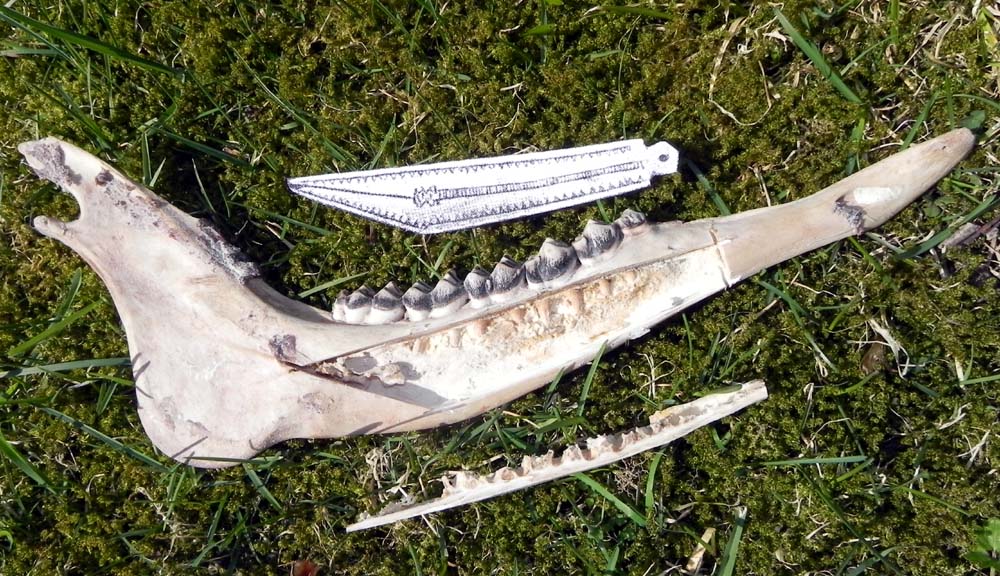
I finished the three Beothuk pendant reproductions that I've been working on over the past week or so.  I made them from caribou mandibles.  This was the first time I used caribou mandibles as the source for the bone, so it was a bit of an experiment.  Based on what I saw this past week, I will certainly use jawbones for pendant blanks again.  I wouldn't say that all Beothuk Pendants were made from caribou mandibles, but I feel that many of them likely were.

Beothuk Bone Pendant Reproductions. Range in length from 8 cm - 12.5 cm
The surface shown here is the smooth, exterior surface of the bone.  The interior surface tends to be a little rougher.  I signed them with tiny "TR"s along the lateral edge (not visible in this photo), so they won't be confused for the original artifacts.

Caribou Jawbones make good blanks
The mandibles provide good dense bone which is a perfect match for the thickness of the flat pendants and the slight curves and undulations seen in many of the original artifacts are very good matches for the blanks that come out of a caribou jaw bone.  The inside of the mandible has a little more surface texture, but its still very dense and holds the incised pattern quite well.
These are Beothuk bone pendants (and other bone pieces) on display in the Mary March Museum in Grand Falls-Windsor.

The interior, rough side 
I tried three areas of the jawbones for pendant blanks; the inside of the body of the mandible, the outside of the body of the mandible, and the ascending ramus.  The best bone came from the outside of the jawbone - it was the flatest and smoothest and provides the largest workable area.  The inside of the jawbone is a close second, although it has a slightly more irregular surface and the blanks aren't quite as flat.  The ascending ramus didn't work so well.  The bone on that part of the mandible is so thin that its translucent and I felt that it would create too fragile of a pendant.  It would also be very easy to gouge right through it while incising the pattern.

 Cathy Driedzic watercolour
I wanted to antique each one slightly differently, so that they wouldn't all look like they were made by one person at the same time.  I used red ochre for the finish, but I stained the blanks to different degrees with tea and charcoal to help change their appearance.  The archaeologist who commissioned these reproductions intends to display them together as a set and grow the collection over time.  I'm looking forward to seeing the collection grow.

This is a detail from Cathy Driedzic's watercolour Beothuk Bone Pendants.  Lori bought this painting for me in 2007 from a Craft Council Gallery show timed to coincide with the Canadian Archaeology Association's annual conference in St. John's. One of the pendants in this set happens to be the same as one in Cathy's painting.

 Photo Credits: Tim Rast

Monday, May 9, 2011

Pendant Pencil Patterns

Beothuk Pendant progress
I made some progress on the Beothuk bone pendant reproductions.  I have the blanks finished and some of the major incised decorations carved.  I don't usually incise all the lines in one session.  Maybe its just my short attention span and the tendency of the pencil lines to smudge, but I usually incise the long outlines first and then mark out and add the short ticks and pattern details in a second and sometimes third carving session.  I use a dremel tool to carve the incised lines.

Checking them against the patterns
These are the pendants made from the caribou mandible blanks. The three pronged pendant is a new blank. Originally, I'd made a blank for that piece from the ascending ramus of a caribou mandible (the part that attaches to the skull), but it turned out to be too thin and fragile. The new blank is made from the body of the mandible, under the teeth - the same as the other two pendants.


Most of our basement look like this
The pendants aren't the only thing I'm working on - they are just the least repetitive things to blog about.  There are still dozens and dozens of points to knap and assemble into jewelry for spring wholesale orders.  That's what is filling up most of my days and nights, although Lori and I did get away to her parents cabin for a nice mother's day visit with the family, yesterday.  A highlight for me was the frequent visits from the new ravens living on an island in the middle of the pond.


A pair of ravens moved into the neighbourhood of Lori's parent' cabin.
Photo Credits: Tim Rast
Related Posts with Thumbnails