 |
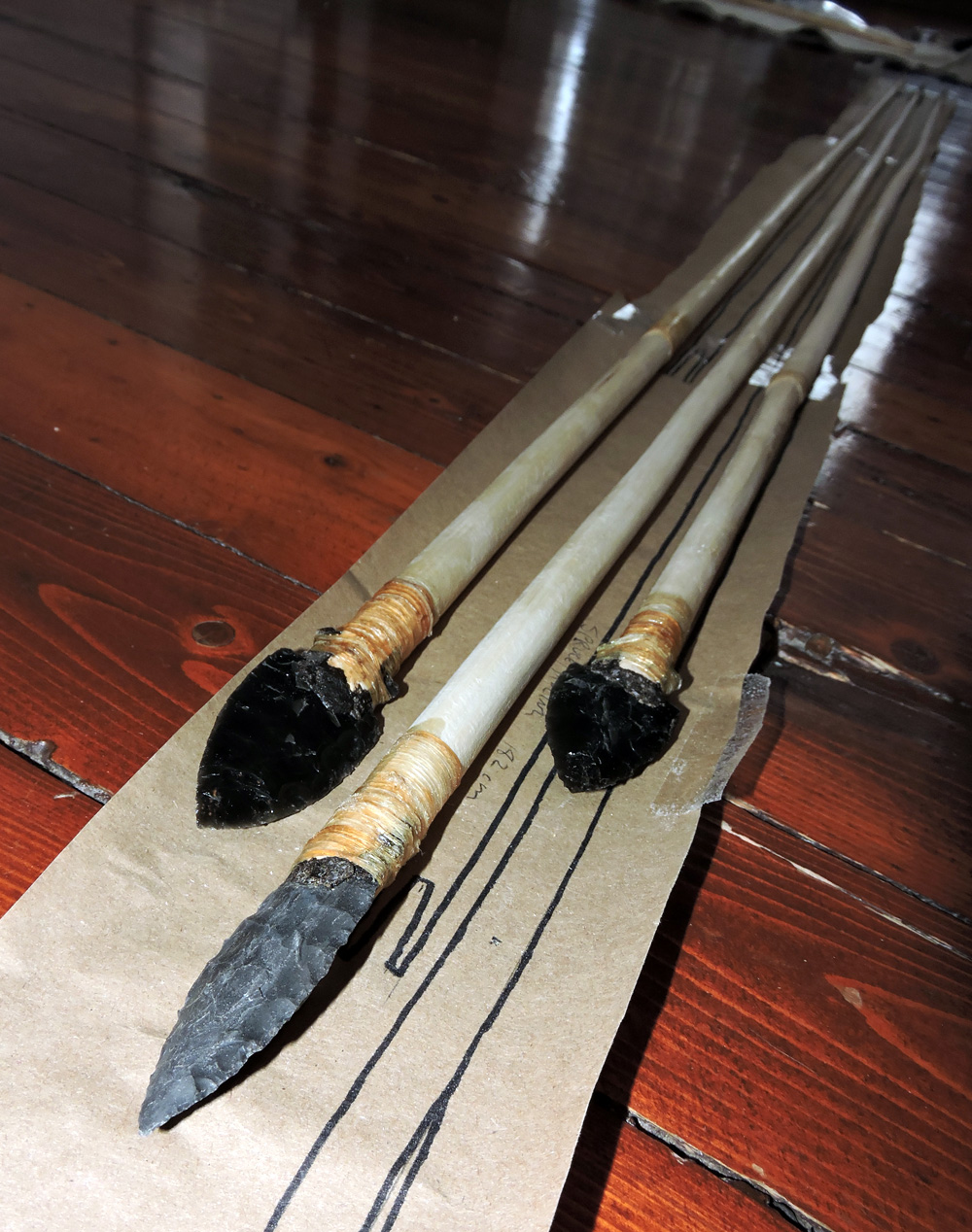
Chert and obisidian atlatl darts representing finds
form Ice Patches in the Yukon and Alaska's
Northern Archaic |
Here's one last look at the Northern Archaic darts heading to Alaska and the Ice Patch dart that is on it's way to the Yukon. This project began several months ago with a request from Jeffrey Rasic with the National Parks Service in Fairbanks, Alaska to make an atlatl and dart set based on artifacts from the area. He sent me some Wiki Peak obsidian to make Northern Archaic (ca. 5000BP) dart points from and put me in touch with Greg Hare in the Yukon to help fill in the blanks with the organic part of the tools.
 |
| A simple birch atlatl and the ice patch dart |
The ice patch darts recovered by Hare and his colleagues over the past couple of decades served as the models for the dart shafts. That led to adding a direct reproduction of an Ice Patch dart to the order for Hare. Unfortunately, there haven't been any atlatls found in either area for the time periods in question, so we decided that a simple hooked stick would be the safest way to represent that part of the kit. As the order evolved we added a lithic production sequence showing how a dart point would be made from a core of obsidian and a second Northern Archaic dart for one of Rasic's colleagues.
 |
| This 4-stage production sequence runs from left to right, with an obsidian primary flake on the left side of the image, through to a bifacially worked blank, a finished projectile point, and the hafted point on the far right. The small flakes between the flake, biface, and projectile point are about 1/10th of the total number of flakes removed to advance the piece to each stage. Conifer pitch, red ochre, and sinew were used to haft the point. |
 |
| The Northern Archaic darts are hafted with ptarmigan feathers. Modified ptarmigan feathers have been found in ice patches, although it's not clear if they were used as fletching. We decided to use ptarmigan feathers on the darts heading to Alaska because they are from non-migratory birds, which should not have any issues crossing international boundaries. |
 |
| The Ice Patch dart head is hafted into it's 182 cm long birch shaft with red ochre and spruce gum. The lashing is sinew and hide glue. |
 |
| The middle dart is the ice patch dart, fletched with duck feathers. According to Hare, there are a couple of different fletching methods found on the ice patch darts. Some use whole feathers with sinew passing through the rachis of the feathers. The earlier darts use split feathers lashed in place with sinew. I used the split feather method, but would love to try sewing the sinew through whole feathers some day. My one regret is that the fletching is relatively short on these darts - around 15 cm long, while Greg Hare told me that at least one of the darts was found with feathers 30-35 cm long. To find feathers that long you'd need to use birds of prey, migratory fowl, or non-local bird species, like turkeys. These darts needed a compromise either in the species used or the size of the fletching and in this case I went with the size of the feather rather than substituting a foreign species. But maybe turkey feathers would create a more accurate looking reproduction. Something to consider for next time. |
 |
| The Northern Archaic darts were made with foreshafts with a conical insert that fits into a sinew reinforced socket on the main shaft. The design of these forshafts is based on ice patch specimens. |
 |
| All three darts have a dimple in the end to fit the pointed spur of the atlatl. |
 |
| The birch atlatls are simple and nondescript. I used the length of my arm from the tip of my outstretched finger to my elbow as a guide for their lengt. |
 |
| The Northern Archaic darts flank the ice patch dart in the middle. It's hard to photograph these things because they are so long and skinny. The ice patch dart is a one piece dart, without a foreshaft. It's the longer of the three at a little over 185 cm long (6'1" or so). |
Photo Credits: Tim Rast



 PDF
PDF


