Friday, August 5, 2011

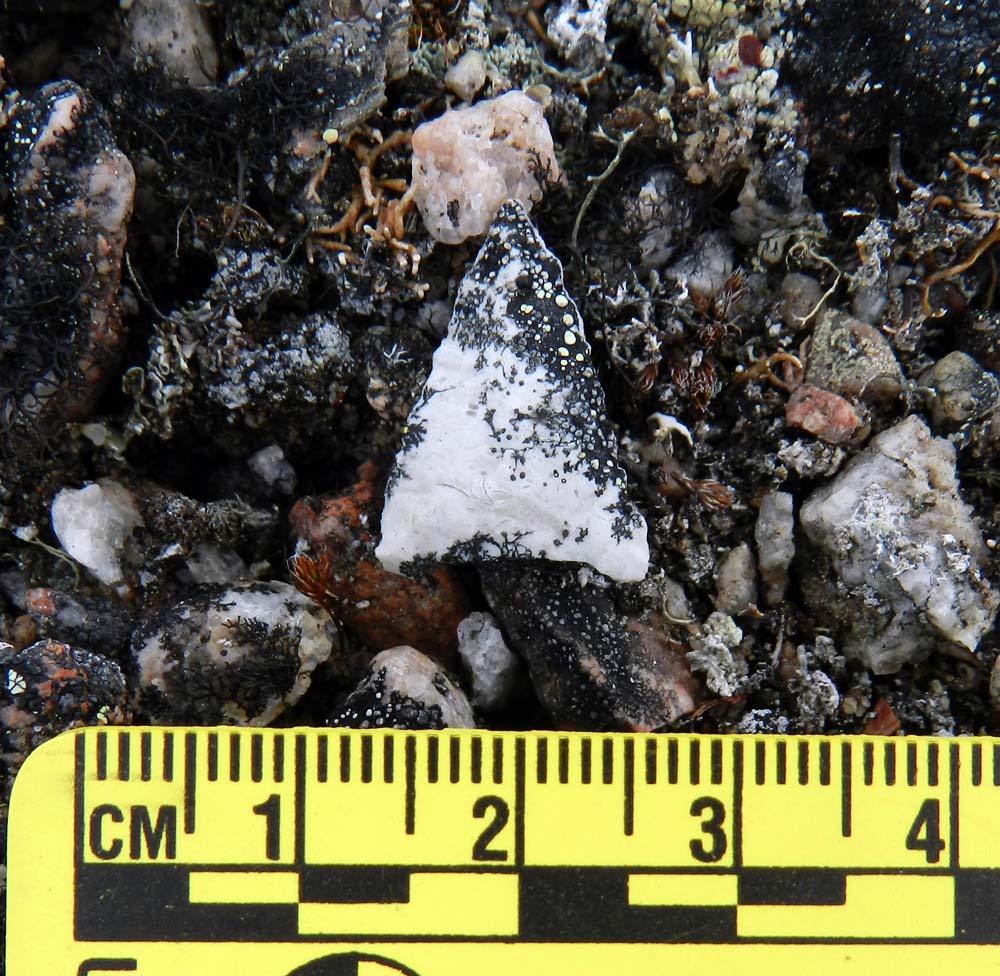
Spot the Dorset Endblade


In theory, surface artifacts should be easier to spot than buried ones.  There is a Dorset endblade and at least 4 flakes in the above photo.

Over the millenia, lichen adds its own Arctic camo to artifacts lying on the ground surface.

Photo Credits: Tim Rast

Wednesday, August 3, 2011

Labrador 2002 - Sky

We saw some remarkable sky-scapes in 2002.  I was helping my friend Chris with his MA fieldwork on a few small islands outside Cartwright.


Photo Credits: Tim Rast

Monday, August 1, 2011

MV Nuliajuk

Andrew Qappik and MV Nuliajuk
In November of 2010, I had a chance to meet Andrew Qappik, a printmaker from Pangnirtung who was visiting Newfoundland to paint the bow of a new fisheries research vessel for Canada's Arctic.  The boat, named the MV Nuliajuk, was commissioned in Iqaluit earlier this July and is now at work in Nunavut's waters.  You can read more about the vessel and see additional photos in the Northern News Service and Nunatsiaq online editions.

Here are a few photos from Andrew's work painting the boat as it was being built in Glovertown, Newfoundland and Labrador.  The name of the vessel, MV Nuliajuk,  comes from the goddess or mother of the sea and it was her image that Andrew painted on the vessel.

Planning the layout of the design.

Andrew had to work from scaffolding, wearing a life jacket over the water.

The painting took about 3 days to complete.

Beautiful work

There was still about 8 months of work to complete inside the research vessel at this point.

I like that her tail is more like a beluga than a fish.

Me, Andrew and Nuliajuk

Photo Credits: 
1-7: Tim Rast
8: Lori White

Friday, July 29, 2011

The Power of Tunniq

After admiring Germaine Arnaktauyok's work for several years, we finally picked up one of her prints from Iqaluit Fine Arts Studio this week.  Its called The Power of Tunniq and I can't wait to see it framed and hanging in our house!  The people that archaeologists call the Dorset or Palaeoeskimo, are called Tunit (Tunniq, singular) by the Inuit.  The Tunit lived in the Eastern Arctic before the Inuit came and there are many Inuit legends about them, including their prodigious strength.  The Tunit were said to be so powerful that they could fling a walrus on their back and carry it home from the hunt.
Germain Arnaktauyok, The Power of Tunniq, 2006

Photo Credits: Tim Rast

Wednesday, July 27, 2011

A few little old reproductions from Labrador

This is a little set of miniature ivory Thule harpoon heads that I made a few years ago for an archaeologist working in Northern Labrador.  Miniatures can be informative, because they sometimes show how composite pieces were assembled.  For example, the endblade on the little harpoon head on the right would have been metal or ground stone on a full scale harpoon head.  The miniature gives a clue to the relative proportions and fit of the endblade on an actual harpoon head. The business card/photo scale is also pretty cool - I need to have some made up for Elfshot.
Both of these points are made from quartz and are based on artifacts from Labrador.  I remember the white quartz being particularly difficult to work.  I like the look of the clear quartz endblade - I definitely need to make more of those.  It was a few years back - but I believe these ones were made for the archaeologist who found the originals.  
Photo Credits: Tim Rast

Monday, July 25, 2011

Pre Dorset Burin

Pre Dorset Burin

There is a little grinding on the burin around the tip.

Photo Credits: Tim Rast

Friday, July 22, 2011

Stemmed Microblade

A little Palaeoeskimo stemmed microblade, in situ amongst pebbles.
Photo Credits: Tim Rast
Related Posts with Thumbnails