Wednesday, September 14, 2011

Review: Stoney Knoll 1m Drawing Square

1m Drawing Square in use
 We took a couple Stoney Knoll 1 metre drawing squares with us into the field this summer.  I love mapping, but hate measuring, so this is probably my favourite new piece of field gear.  Its sturdy, collapsible, and accurate.  I've tried making 1m drawing grids in the past, but they always warped and I never figured out a way to make them collapsible.   The Stoney Knoll squares come apart into four 1 metre long rods and eight elastic grid strings, and come with a sturdy canvas shoulder bag for storage and transport.

Bungie strings stretch over obstacles 
Each of the red grid strings is a bungie cord with a ring on each end.  The rings fit over knobs attached to the yellow frame.  The stretching grid strings make them quick to assemble and disassemble, but they are also handy while you are using them.  They stretch over and around rocks that might be in the middle of your unit and if you are careful, you can even step onto the screen while you are mapping, without fear of moving or breaking your drawing square.

20 cm grid squares - good for big rocks
 The hollow square aluminum rods are held together at each corner by plastic "L" connectors to create a solid 1m x 1m frame.  The version that we bought had 8 strings and was divided into 20cm grid squares, which seemed to work well with the scale of rocks and features that we were mapping.  Occasionally, we wished for 10cm grid squares.  I see from their website that Stoney Knoll, now has a Deluxe drawing square with 10cm grid squares. Nice!

Legs would be awesome!
If the Stoney Knoll designers are looking for an Ultra Deluxe model, it might be great if it had collapsible legs on each corner.  Occasionally we were mapping very uneven ground surfaces and had to balance the screen on makeshift supports using buckets, nails, dustpans, camera bags, files, or whatever else we could find to level it.  If the square had built in or attachable legs it would solve that problem.

Great product.
Even when it wasn't being used to map, the 1m square was handy to have on site as a guide to quickly set up new units - just line it up on your existing grid and pop in stakes at the corners and you are good to go.  It came with a sturdy canvas bag with a shoulder strap for the frame and a smaller nylon bag to store the strings in.    Our screens are still in good shape after 3 months of daily use and I'm sure that we'll get several more field season out of them.  Everyone maps at a different pace, but for me, these grids let me map a 1x1m unit in about 1/4 the time of using a measuring tape to measure in each rock.  At $140US, they are worth the investment and pay for themselves with time saved and frustration averted.

Photo Credits: Tim Rast

Monday, September 12, 2011

Now the paperwork begins...

Bags of Artifacts
So, we're home now.  It was a fantastic long summer.  There was snow on the ground when we arrived in Nunavut in the middle of June and we had spring, summer and fall while we worked.  We had a few days of snow and sleet towards the end of the season.  Now I have several months of report writing.  My part of the project involves reporting on about 25 sites.  The first step will be to send the site record forms away to Ottawa to get Borden numbers for the new sites.  While I'm working on the reports I'll have the artifacts from the excavated sites with me here in St. John's, before passing them on to the Prince of Wales Northern Heritage Centre in Yellowknife.
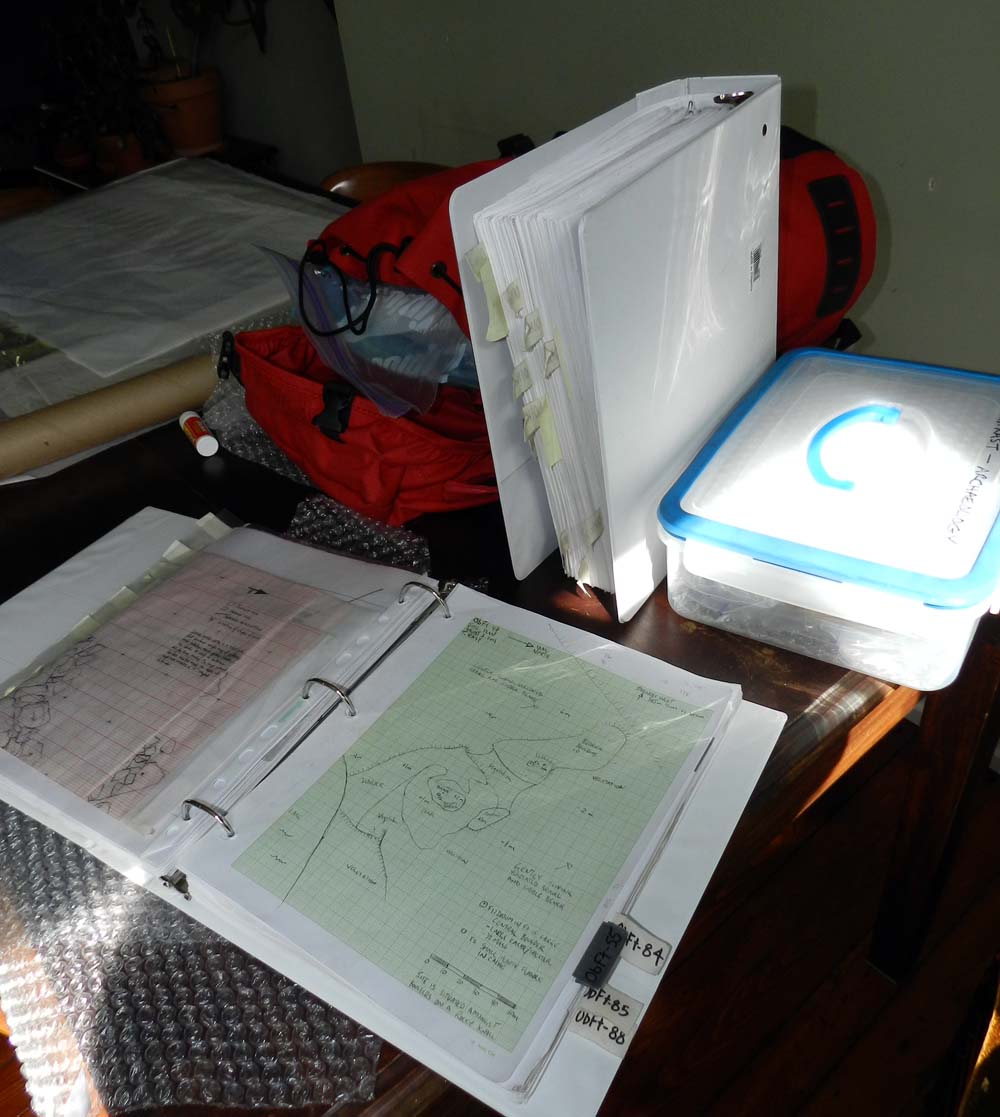
I have two fat binders of maps and paper work, bags of artifacts and thousands of photographs to organize into a final report for the Nunavut Government and the client.


At least I get to have a few cool artifacts around the house.

Photo Credits: Tim Rast

Friday, September 9, 2011

Caribou!


I finally got to see some caribou!


On our last day in the field camp, I saw one of the polar bear monitors coming back to the tents like this, so I knew that he'd seen a bear or caribou.

Fortunately, it turned out to be caribou.


They're pretty skittish, so mostly I got photos of tails running away from us.

We saw five all together - one big male and what looked liked two females and two calves.

It was nice to see them.  A group of five caribou had been seen in the area earlier in the summer, so perhaps this was them.


Photo Credit: Tim Rast

Wednesday, September 7, 2011

Last Day of Fieldwork

Today is our last day in the field. We spent the morning looking under rocks and back-filling our excavation.

This little Pre-Dorset box hearth was one of the highlights from this site.

The fitted upright slabs were buried deep in the sand and gravel beach, creating a small hearth about the same size and shape as a Chinese food take-out carton.
Photo Credits: Tim Rast

Monday, September 5, 2011

Snow Geese

The Snow Geese are gorging on berries and the young grey babies are practicing their flying in anticipation of the long flight south.  Its fall in Nunavut and the rain is as likely to fall as drops or snow flakes these days.  I'll be home in less than a week.


Photo Credits: Tim Rast

Friday, September 2, 2011

Surface Find: Notched Slate

Soil formation in the Arctic is so slow, that often artifacts that are thousands of years old are still lying on the ground surface.  I didn't spot this little notched slate artifact - the guy in red did.

Its broken through the middle and would most likely have been a Dorset Palaeoeskimo lance point.    The point  is missing.

The broken edge may have served as a scraper after the tip snapped off.

Photo Credits: Tim Rast

Wednesday, August 31, 2011

Labrador 2002 - Land

These are some of my favourite photos from the summer of 2002, in and around Cartwright, Labrador.


Photo Credits: Tim Rast
Related Posts with Thumbnails